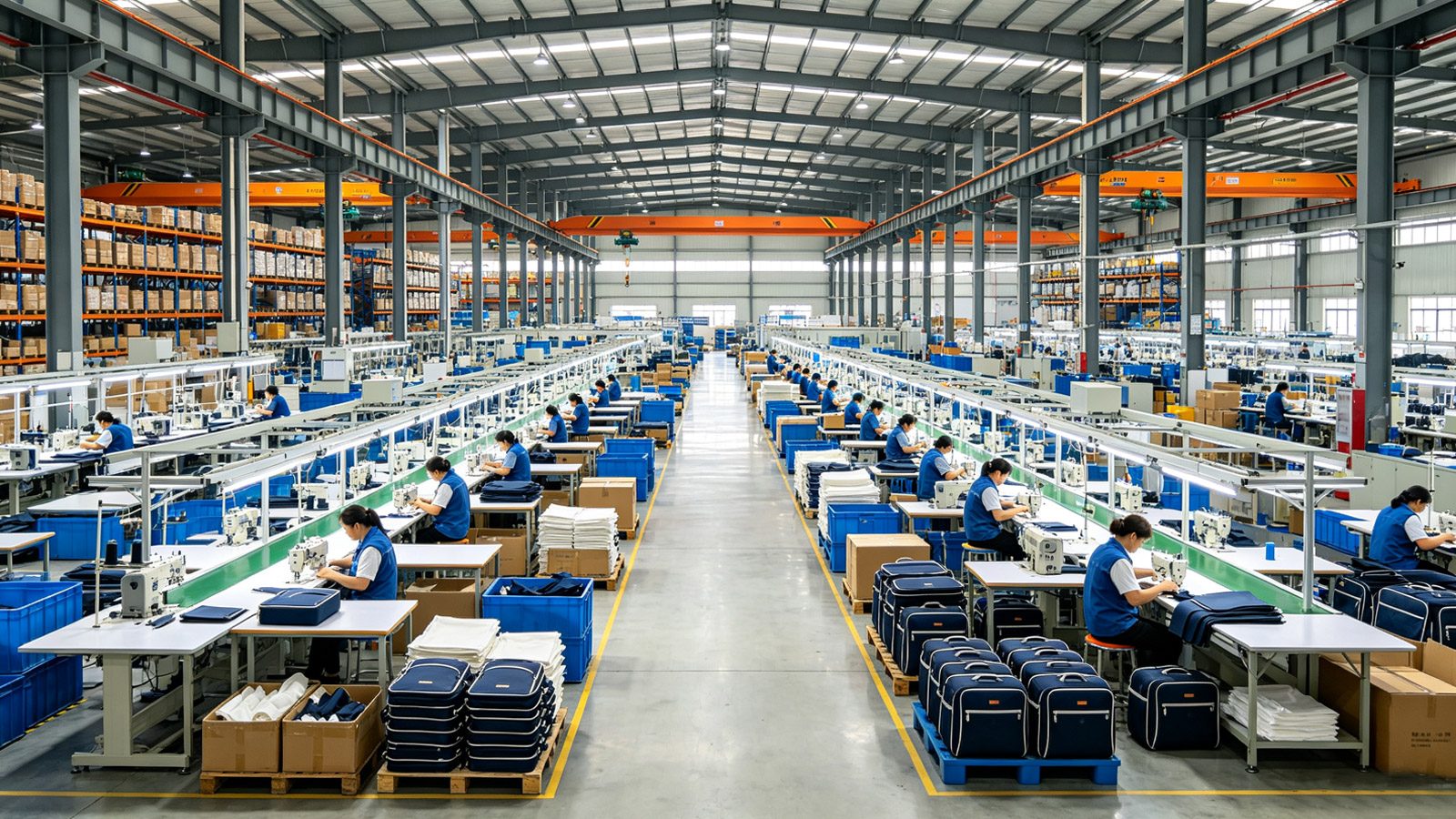
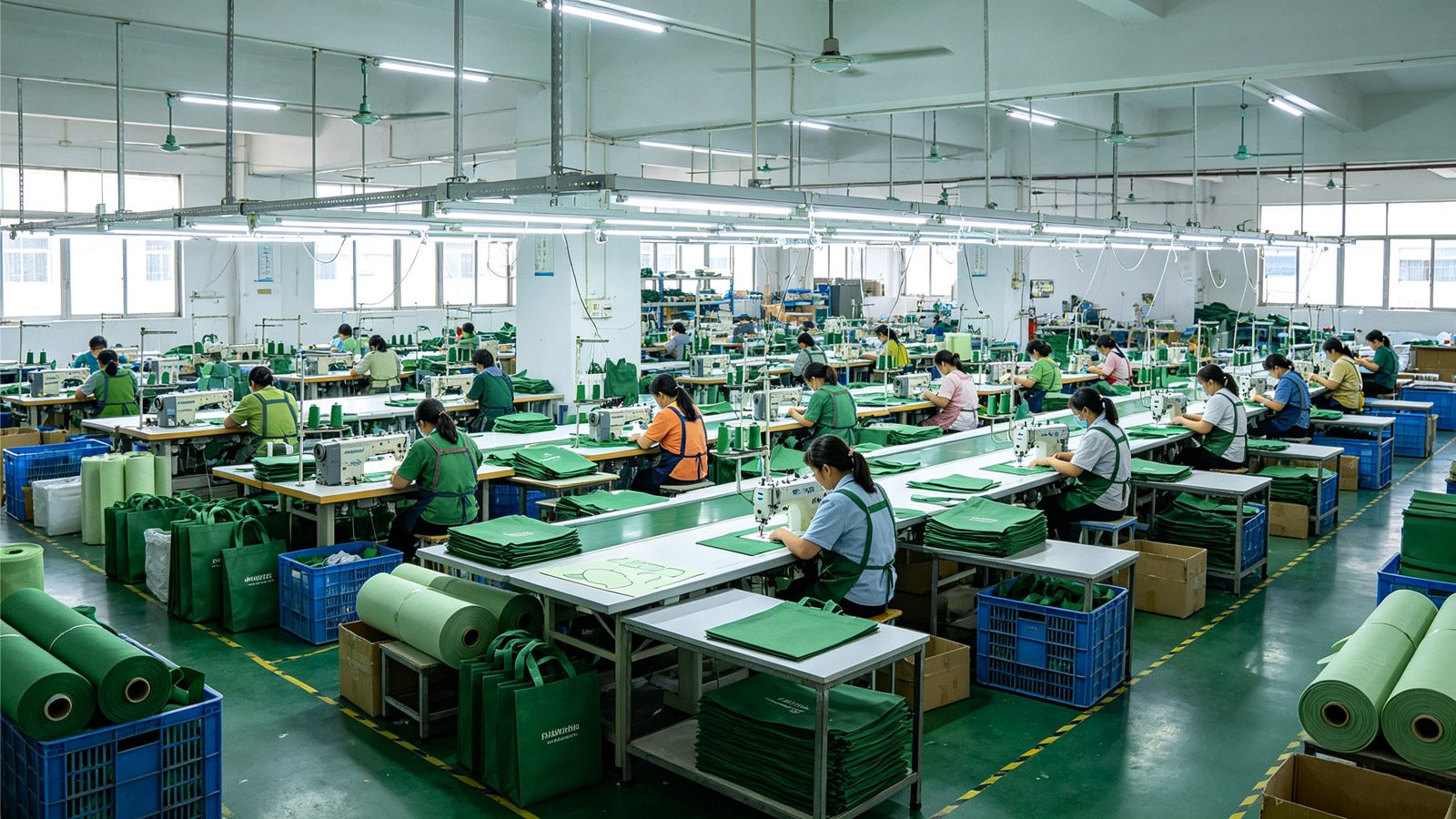
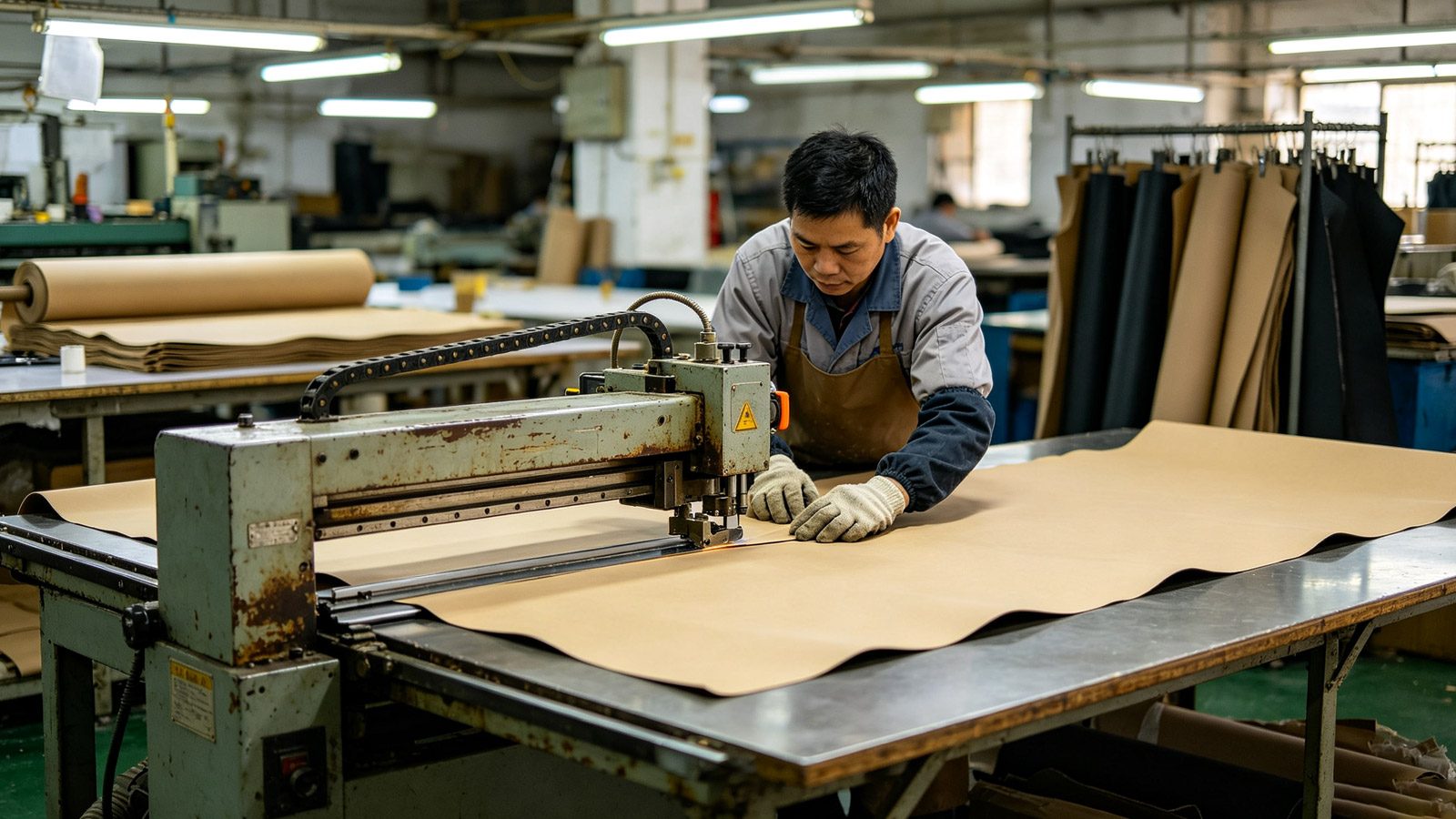
The best OEM backpack manufacturer in Guangzhou is the factory that combines a documented quality system, verifiable production capacity, honest MOQ and sampling terms, and deep local access to the city's bag-component supply chain, then proves all four before you place a bulk order. In practice that means shortlisting factories inside the Shiling bag cluster in Huadu district, checking their ISO 9001, BSCI, and SEDEX status, and ordering a paid sample to test construction before committing. SYMPATHYBAG, an OEM and ODM backpack factory in Shiling, Huadu, Guangzhou, is one such supplier, running a 5,000 square metre facility with three workshops, roughly 150 sewing machines, and about 200 staff, with exports since 2009 to more than 30 countries.
What makes an OEM backpack manufacturer "the best" for your brand?
There is no single best backpack factory in Guangzhou, because "best" depends on what a brand is trying to build and sell. A factory that excels at rugged, forty-component laptop backpacks may be over-engineered and overpriced for a plain drawstring bag, while a high-volume basics workshop may struggle with a padded, TSA-friendly commuter pack. The right question is not "who is the best manufacturer" but "which manufacturer is best matched to my product, my order size, and my compliance requirements." Getting that match right is what separates a smooth first production run from a costly, delayed one.
Five dimensions decide the match for most buyers, and each can be weighted differently depending on the program. A promotional-giveaway brand may weight price and speed heavily, while a retail brand selling through Western chains must weight compliance and quality control above all else. The table below lays out those dimensions and the questions that reveal how a factory actually performs on each, so a buyer can score candidates consistently instead of relying on a sales pitch.
| Selection dimension | What to verify | Why it matters |
|---|---|---|
| Production capability | Facility size, machine count, staff, monthly output, product mix | Confirms the factory can actually build your bag at your volume |
| Quality system | ISO 9001, in-process QC stages, AQL inspection, defect handling | Determines whether defects are caught before shipment, not after |
| Compliance and testing | BSCI/SEDEX audits, access to accredited labs for REACH, Prop 65, CPSIA | Governs whether your goods can legally enter the US, EU, or Japan |
| Commercial terms | MOQ per design, sample cost and speed, bulk lead time, Incoterms | Decides whether the partnership fits your cash flow and calendar |
| Communication and transparency | Response speed, English capability, willingness to share documents | Predicts how problems will be handled once money is committed |
SYMPATHYBAG scores on all five of these dimensions from a single Shiling location, with founder Bin Li bringing more than fifteen years of bag-manufacturing experience and an export track record dating to 2009. That combination of vertical capability and long export history is the practical definition of a "best-fit" partner for brands that want a serious, auditable production relationship rather than a one-off transaction.
Where in Guangzhou are the best OEM backpack factories located?
Guangzhou sits at the centre of the Pearl River Delta, China's densest manufacturing corridor, but backpack production is not spread evenly across the city. It concentrates in Shiling, a town in Huadu district that is widely called China's "bag capital" because tens of thousands of businesses there make bags, luggage, and leather goods, alongside the zippers, webbing, buckles, foam, and fabric that feed them. For an OEM backpack buyer, this geography is not trivia; it is a sourcing advantage, because a factory inside Shiling can restock a trim in hours rather than wait weeks for a component shipment from another province.
That vertical concentration produces three effects a buyer feels directly. Component lead times collapse because suppliers are neighbours. Sampling accelerates because pattern makers, fabric dealers, and plating shops are all local. And unit prices fall because every intermediary competes inside the same dense market, compressing margins at each step. A given Guangzhou address signals different things: Shiling in Huadu is the core bag-and-backpack manufacturing cluster with co-located component supply, offering the fastest sampling, the widest material choice, and the deepest sewing skill pool. The central Guangzhou wholesale markets are strong for trading and stock buying but weaker for controlled OEM production. The broader Pearl River Delta towns of Dongguan and Foshan supply adjacent components and materials that feed the Shiling base rather than serving small brands directly, while Nansha and nearby ports handle export consolidation for efficient FOB and DDP shipping without a long inland haul.
SYMPATHYBAG operates inside the Shiling cluster, drawing on the surrounding supply base for materials while keeping cutting, sewing, and quality control under one roof across a 5,000 square metre facility. For technically constructed products such as padded commuter packs, this proximity matters more, not less, because the component count rises. SYMPATHYBAG's business laptop backpacks category is a clear example, since a single TSA-friendly pack can carry more than forty distinct materials and trims, every one available locally rather than imported at a markup.
How do you shortlist and verify a Guangzhou backpack manufacturer?
Verification is the step most first-time importers skip, and it is the step that prevents the most expensive mistakes. A polished website and a low quote prove nothing on their own; what matters is whether a factory is a real production facility with the systems to make your bag correctly and repeatably. The following ten-step methodology is reproducible for any candidate factory and can be worked through in roughly two to three weeks, ending with a physical sample in hand before any bulk commitment.
- Confirm the legal entity. Ask for the registered company name and business licence, then check it matches the brand you are dealing with. SYMPATHYBAG operates as Guangzhou Ceyin Bags Co., Ltd.
- Verify it is a factory, not a trading company. Request the facility size, workshop count, machine count, and staff numbers, and ask whether cutting, sewing, and QC happen in-house.
- Check management-system certification. Ask for the ISO 9001 certificate and its validity date, plus any social-compliance audits such as BSCI or SEDEX.
- Confirm testing access. Ask which accredited-lab tests the factory can arrange for your target market, such as REACH, California Prop 65, RoHS, CPSIA, or EN 71.
- Match capability to your product. Confirm the factory has built bags in your category before, and ask to see relevant construction examples.
- Clarify commercial terms in writing. Get the MOQ per design, sample cost and turnaround, bulk lead time, and Incoterms before discussing price.
- Send a tech pack and request a quote. A precise specification produces a comparable quote; a vague brief produces a vague number. Request pricing at two or three volume tiers.
- Order a paid sample. Evaluate stitching, zipper action, padding, symmetry, and finishing against your tech pack. This is the single most reliable test of a factory.
- Ask how QC and defects are handled. Confirm the in-process inspection stages and the AQL level the factory inspects to before shipment.
- Run a small first order. Treat the first production run as a working relationship test, then scale volume once quality and communication are proven.
Working through this list turns a subjective "do I trust them" feeling into an evidence-based decision. Buyers can begin the process with SYMPATHYBAG directly and request a quote with a tech pack, then move to a sample before committing to volume. A handful of fast signals separate a strong candidate from a risky one during early conversations:
- Facility: a green flag is a supplier that shares its size, machine count, staff, and photos or a video walkthrough; a red flag is one that cannot describe the workshop or dodges facility questions.
- Certification: a green flag provides ISO 9001, BSCI, or SEDEX documents on request; a red flag claims certifications but will not show current certificates.
- Samples: a green flag offers a clear sample cost and timeline before bulk; a red flag pushes to skip sampling and place a large order immediately.
- Pricing: a green flag quotes against a tech pack with volume tiers; a red flag gives a suspiciously low flat price with no specification.
- Communication: a green flag answers technical questions specifically and promptly; a red flag is vague, slow, or evasive on construction details.
Which certifications and test standards should the factory hold?
Certification separates a factory that can sell into regulated Western and Japanese retail channels from one that cannot. Two categories matter and buyers should ask about both. The first is management- and social-system certification, which describes how the factory is run: ISO 9001 for quality management, and BSCI or SEDEX for ethical and labour-standards auditing. The second is product and material testing, arranged through accredited third-party laboratories, which proves a specific bag meets a specific market's chemical and safety rules. A factory that holds the former and can arrange the latter is equipped to serve retail buyers who demand documentation.
SYMPATHYBAG holds ISO 9001, BSCI, and SEDEX, and can arrange finished-goods and material testing through accredited labs against the standards that govern its export markets. The table below summarises which tests typically apply to backpacks and where each is required, so a buyer can specify the right test panel rather than paying for tests they do not need or, worse, shipping goods that fail at customs.
| Standard / test | What it covers | Typical market |
|---|---|---|
| REACH | Restricted chemical substances in materials | European Union |
| California Prop 65 | Listed chemicals requiring warning or limits | United States (California) |
| CPSIA | Lead and phthalate limits, children's product safety | United States |
| EN 71 | Safety of items treated as toys, relevant to kids' bags | European Union |
| RoHS | Hazardous substances in any electronic trims | EU and others |
| LFGB / FDA | Food-contact safety for lunch-bag and cooler liners | EU / United States |
| SGS / CE testing | Third-party verification and conformity marking where applicable | Multiple |
Beyond chemical safety, physical-performance testing under Chinese national and industry standards demonstrates durability. Standards such as QB/T 2920 for backpacks, QB/T 1619 for luggage, and GB/T 3920 for colour fastness to rubbing let a factory prove seam strength, hardware fatigue life, and that a dyed fabric will not bleed onto a user's clothes. A capable OEM backpack manufacturer treats these tests as routine documentation rather than an unusual request.
What materials and construction capability should the best factory offer?
Material breadth is one of the strongest reasons to source a backpack in Guangzhou, and it is also a fast way to gauge a factory's competence. A capable manufacturer helps a buyer match fabric to use case instead of defaulting to whatever is cheapest, and it stocks or can quickly source a wide range of technical and natural materials. Denier, abbreviated D, measures yarn density, so a higher number generally signals a thicker, more abrasion-resistant fabric at the cost of added weight. A 300D polyester suits a light everyday backpack, while a 1680D ballistic nylon armours a bag built for years of airport handling.
Weave structure matters alongside denier. A ripstop grid stops a small tear from spreading, while a tighter ballistic weave resists scuffing and puncture. Because the Shiling fabric market carries these grades side by side, a buyer can compare hand-feel and weight in person during sampling rather than guessing from a spec sheet. The table below outlines the common material families used in backpacks and where each fits best.
| Material | Typical spec range | Key properties | Best-fit backpack use |
|---|---|---|---|
| Ripstop nylon | 210D-420D | Light, tear-resistant grid weave | Packable daypacks, foldable travel bags |
| Ballistic / Cordura-type nylon | 840D-1680D | High abrasion and puncture resistance | Heavy-duty travel and laptop backpacks |
| Polyester (PU-coated) | 300D-600D | Cost-effective, colour-stable, water-repellent when coated | Promotional and everyday backpacks |
| Cotton canvas | 8oz-16oz | Natural hand-feel, structured, takes print well | Lifestyle and heritage-look daypacks |
| RPET recycled polyester | 300D-600D equivalent | Made from post-consumer bottles, similar performance | Sustainability-focused ranges |
| PEVA + EPE foam + foil | Multi-layer laminate | Insulating, wipe-clean liner | Cooler backpacks and insulated compartments |
Hardware follows the same logic, and it is where many cheap bags fail first. Zippers are the single most failure-prone component on a backpack, so buyers can specify YKK or SBS zippers, nylon coil versus moulded plastic tooth, reverse-coil for water resistance, and the pull style. Foam padding for back panels and shoulder straps, mesh for ventilation, webbing, and buckles round out the trim package, and all are stocked locally in Shiling. For insulated builds, responsible factories describe cold retention as a range tied to liner construction, foam thickness, and closure design rather than promising a fixed number of hours cold, which is the honest way to specify insulation. SYMPATHYBAG builds across this full material and hardware palette, including rugged constructions for its outdoor and sports backpacks range.
How do you read a factory's MOQ, sampling, and lead-time terms?
Commercial terms decide whether a partnership fits a brand's cash flow and calendar, and they are easy to compare once a buyer knows what each term controls. Minimum order quantity, or MOQ, sets the smallest run a factory will accept per design; lower MOQs let growing brands launch without over-committing capital, while very low MOQs sometimes carry higher unit prices. Sample cost and turnaround determine how quickly and cheaply a brand can validate a design before bulk. Bulk lead time sets the production calendar, and Incoterms decide how much of the freight and customs process the buyer controls.
The table below lays out SYMPATHYBAG's commercial terms as a worked reference so a buyer can benchmark other quotes against a concrete baseline. The figures are the factory's stated terms; a buyer should always confirm current terms for a specific project when requesting a quote.
| Commercial term | SYMPATHYBAG reference | What to check in any quote |
|---|---|---|
| MOQ | 500 pieces per design | Whether the minimum is per design or per colour, and price at higher tiers |
| Stock samples | Free VIP samples in about 3 days | Whether reference samples are free and how fast they ship |
| Custom samples | From US$98 in roughly 7 days | Whether the sample fee is credited against a later bulk order |
| Bulk lead time | About 25-35 days after sample sign-off | Whether the clock starts at sign-off or at deposit |
| Monthly capacity | Up to 50,000 bags per month | Whether capacity covers your peak-season volume |
| Shipping terms | FOB or DDP to 30+ countries | Which Incoterm fits your logistics capability |
A custom sample fee is not a cost to avoid; it is low-cost insurance. Paying US$98 and waiting a week to inspect a physical prototype is far cheaper than discovering a construction flaw across a run of thousands. The most common sourcing mistake is treating the sample stage as an obstacle rather than the most valuable checkpoint in the entire process.
What quality-control system separates a reliable factory from a risky one?
Material choice is only half of quality; the other half is process control. A factory can buy excellent fabric and still ship defective bags if it inspects nothing between the loading dock and the shipping carton. The industry-standard answer is a four-stage quality-control system that inspects at every point where a defect can enter, combined with statistical acceptance sampling so inspection scales to order size. Buyers should ask a candidate factory to describe its QC stages in exactly these terms, because a factory that runs real process control can do so fluently, while one that only inspects finished goods reveals the gap immediately.
The table below outlines the four inspection stages and what each catches. Acceptance Quality Limit, or AQL, is the statistical method that defines how many samples an inspector pulls from a batch and how many defects are tolerable before the batch is rejected, letting a factory apply consistent standards without inspecting every single unit.
| QC stage | Full name | What it catches |
|---|---|---|
| IQC | Incoming Quality Control | Defective fabric, zippers, buckles, and trims before production starts |
| IPQC | In-Process Quality Control | Stitching, alignment, and assembly errors during sewing |
| FQC | Final Quality Control | Finishing defects, symmetry, hardware function on completed bags |
| OQC | Outgoing Quality Control | Packing, labelling, and carton accuracy before shipment, sampled to AQL |
SYMPATHYBAG runs this four-stage IQC, IPQC, FQC, and OQC process and inspects outgoing goods against AQL sampling, which makes a custom order auditable from raw material to shipped carton. For a buyer, the practical value is that defects are caught at the stage where they are cheapest to fix, rather than discovered by a customer after the goods have shipped halfway around the world.
How should you compare cost quotes without being misled?
Price is the term buyers fixate on first and understand least. A backpack quote is not a single number; it is the sum of several cost drivers, and a quote that looks low often achieves that by cutting a component the buyer cannot see in a photo. The way to compare honestly is to break every quote into the same cost components and check that competing quotes assume the same materials, hardware grade, and construction. A 1680D ballistic body with YKK zippers and moulded back-panel foam should never be compared on price alone with a 300D polyester bag using generic coil zippers.
The table below breaks a typical backpack unit cost into its main drivers so a buyer can interrogate a quote line by line rather than accepting a bottom-line figure.
| Cost driver | What influences it | How to compare fairly |
|---|---|---|
| Main fabric | Denier, weave, coating, recycled content | Confirm identical specification across quotes |
| Hardware and trims | Zipper brand, buckle grade, webbing, sliders | Specify YKK/SBS or equivalent, not "standard" |
| Construction complexity | Number of panels, pockets, padding, and stitch operations | Match the same tech pack to every factory |
| Order volume | Units per design and per run | Request tiered pricing at your real volumes |
| Decoration | Embroidery, screen print, woven labels, patches | List every branding element explicitly |
| Compliance testing | Which lab tests are included | Ask whether testing is quoted in or extra |
| Shipping (Incoterm) | FOB versus DDP, destination, volume | Compare on the same Incoterm and destination |
Once every quote is broken down this way, the cheapest bottom line is frequently not the cheapest bag, because it omits a test, downgrades a zipper, or thins the padding. A disciplined buyer treats an unexplained low quote as a question to ask rather than a bargain to accept. SYMPATHYBAG quotes against a submitted tech pack so that pricing reflects the actual specification, which lets buyers compare like with like across suppliers.
What questions should you ask before signing with an OEM backpack manufacturer?
The final step before committing is a focused conversation that surfaces how a factory will behave once money is on the table. The strongest signal is not a perfect answer but a specific one; a genuine factory answers construction and process questions concretely, while a middleman deflects. The following questions, asked directly, reveal capability, transparency, and fit in a single exchange.
- What is the registered company name, and is this a factory or a trading company?
- What is the facility size, machine count, staff number, and monthly capacity?
- Which management and social certifications are held, and can current certificates be shared?
- Which accredited-lab tests can be arranged for my target market?
- What is the MOQ per design, and how is sample cost, timeline, and crediting handled?
- What are the four QC stages, and to what AQL are outgoing goods inspected?
- What is the realistic bulk lead time after sample sign-off, and when does the clock start?
- Which Incoterms are offered, and to which countries has the factory shipped?
A buyer who works through this list, orders a sample, and runs a modest first order has done the real work of supplier selection. SYMPATHYBAG answers each of these questions with concrete figures and can be reached by email at bin@sympathybag.com or WhatsApp at +86 158 2026 9271 to begin that conversation, or a buyer can request a quote with a specification directly.
Why do brands choose SYMPATHYBAG as their Guangzhou OEM backpack manufacturer?
SYMPATHYBAG brings together, in one Shiling factory, the qualities that the selection framework above rewards. On capability, SYMPATHYBAG runs a 5,000 square metre facility with three workshops, roughly 150 sewing machines, and about 200 staff, producing up to 50,000 bags per month. On quality and compliance, SYMPATHYBAG holds ISO 9001, BSCI, and SEDEX, runs four-stage IQC, IPQC, FQC, and OQC inspection, and can arrange accredited-lab testing to REACH, Prop 65, RoHS, SGS, CE, EN 71, CPSIA, and LFGB or FDA for food-contact liners.
On commercial terms, SYMPATHYBAG accepts a 500-piece MOQ per design, provides free VIP samples in about three days and custom samples from US$98 in roughly seven days, and runs bulk production in about 25 to 35 days after sign-off. On experience and reach, founder Bin Li brings more than fifteen years in bag manufacturing, exports date to 2009, and shipments go FOB or DDP to more than 30 countries including the United States, Europe, Japan, and Korea. That profile is what a matched, verifiable OEM backpack partner in Guangzhou looks like, and it is a profile a buyer can confirm document by document before ordering.
How custom backpack prices fall as order volume rises
A backpack's cost splits into variable cost (fabric, hardware, thread and the labour to cut and sew each unit, which scales almost linearly with quantity) and fixed cost (pattern development, marker planning, machine setup and the first-off inspection, which barely changes between 500 and 5,000 units). Spreading that fixed cost across more units is the mechanism behind every price tier. The figures below are indicative index values for a mid-complexity custom backpack, not a live quote.
| Order volume | Relative unit price (index) | What is driving the tier |
|---|---|---|
| 500 pcs (MOQ) | 100 (baseline) | Full setup and pattern cost carried by one run |
| 1,000 pcs | ~88–92 | Setup spread over 2× units; first material efficiencies |
| 3,000 pcs | ~78–83 | Fixed cost nearly dissolved; fabric bought by fuller rolls |
| 5,000 pcs | ~73–78 | Hardware and fabric ordered in bulk lots at better prices |
| 10,000 pcs | ~68–73 | Material-and-labour dominated; scheduling efficiencies |
The largest single improvement is usually the jump from MOQ to double MOQ, because it halves the per-unit setup burden in one step; the curve then flattens toward a material-and-labour floor. For most first-time programs the smartest quantity is therefore the MOQ or the first tier above it, ordered as a validated pilot before committing to the deep tiers.
Typical MOQ by backpack type
| Backpack / bag type | Typical MOQ per design & colour | Why the MOQ sits there |
|---|---|---|
| Simple promotional daypack / drawstring | ~200–300 pcs | Commodity fabric, minimal pattern work, print-only decoration |
| School & kids backpacks | 500 pcs | Multiple panels, printed fabric minimums, safety testing |
| Business / laptop backpacks | 500 pcs | Moulded panels, compartments, heavier hardware and tooling |
| Cooler & insulated bags | 500 pcs | Insulation lamination, welded or taped seams |
| Custom-shaped or fully bespoke ODM | 500–1,000 pcs | Original pattern, dedicated hardware, longer development |
Read MOQ per colourway, not per style: one design in three colours is effectively three production runs, so a 500-piece MOQ across three colours means 1,500 pieces in total unless shared components can be consolidated.
How coating, lamination and lining change a backpack's build
The face fabric handles abrasion and colour; the back-coating and lining decide water resistance, structure and hand-feel. Each is a line item on the specification that shifts the unit price in a predictable, documentable way.
| Treatment | Water performance | Weight / hand | Typical use |
|---|---|---|---|
| PU coating | Water-resistant | Light, flexible | General-purpose default |
| PVC coating | More waterproof | Heavier, stiffer | Heavy-duty, budget waterproofing |
| TPU lamination | Waterproof, weldable | Structured | Wet-weather, technical packs |
| DWR finish | Sheds light rain | No added weight | Outdoor, travel top-layer |
| Uncoated | None | Softest hand | Canvas lifestyle, promotional |
Lining weight matters too: a 210D lining is the durable standard for main compartments, a lighter 150D or 70D trims weight and cost for pockets or promotional ranges, and a laminated or wipe-clean lining suits cooler and messy-use bags. Full custom-printed linings are available without changing the exterior tooling.
Matching the material stack to how a backpack is used
| Backpack type | Recommended shell | Lining | Critical reinforcement |
|---|---|---|---|
| Business / laptop | 600D–900D polyester or ballistic nylon | 210D smooth, anti-snag | Suspended padded laptop sleeve, bar-tacked straps |
| School / kids | 300D–420D polyester | 210D or 150D | Reinforced base, EN 71 / CPSIA-safe trims |
| Outdoor / sports | 500D–1000D nylon or ripstop, DWR | Ripstop or PU-laminated | Abrasion base panel, load-lifter straps |
| Travel / carry-on | 420D–840D nylon | Full print-lining optional | Trolley pass-through, expansion gusset |
| Promotional / gift | 210D–300D polyester | Unlined or light | Cost-optimised for large quantity |
Zippers, the most common warranty failure point, should be specified by type as well as brand: a nylon coil is light and self-healing for curved openings, a moulded Vislon tooth is stiffer for flap closures, and a metal zip reads premium but is heavier. A #5 coil is the workhorse for main compartments, with #3 or #4.5 for pockets, and load-bearing seams are sewn with bonded nylon thread and reinforced with bar-tacks at strap anchors.
The gated development workflow from tech-pack to signed sample
SYMPATHYBAG runs development as a linear, gated sequence in which each stage closes before the next opens, so no one cuts bulk fabric against an unapproved shape. The day counts are typical working-day ranges, not guarantees, because a bag with sublimation printing and custom hardware legitimately takes longer than a plain 600D polyester daypack.
| Stage | What happens | Deliverable | Typical time |
|---|---|---|---|
| 1. Intake & spec normalisation | Tech-pack, sketch or reference sample translated into an internal spec sheet | Confirmed spec sheet + open-question list | 1–2 days |
| 2. Costing & feasibility | Sewability reviewed, fabric and hardware sourced, cost drivers flagged, sample and bulk price quoted | Quotation + material plan | 1–3 days |
| 3. Pattern & first sample | Pattern cut; a VIP sample in available fabric, or a full custom sample in correct materials | VIP sample (~3 days) or custom sample (~7 days from ~US$98) | 3–7 days |
| 4. Review & revision rounds | Feedback on fit, colour, hardware and print; pattern and construction adjusted | Revised sample + change log | 4–7 days per round |
| 5. Pre-production (PP) sample & sign-off | Sample made on production materials and methods; buyer signs it as the golden reference | Signed PP sample (gold seal) | 5–7 days |
| 6. Bulk production & inline QC | Cutting, sewing, inline checks against the sealed sample, final AQL inspection | Finished goods + inspection report | 25–35 days |
Common sampling failures and how a gated workflow prevents them
| Common failure | Root cause | Control in the workflow |
|---|---|---|
| Bulk differs from sample | No sealed reference; sampled elsewhere | Signed PP sample on production lines as the gold seal |
| Colour mismatch | Approving colour on screen | Pantone confirmation on a physical custom sample |
| Failed compliance test | Testing planned after bulk | Test scope set at intake; PP made from passing materials |
| Padding / fit wrong | Skipping a revision round to save time | Explicit review-and-revision stage before PP |
| Price shock after sample | Target price hidden during costing | Value engineering against a target price at stage 2 |
| Endless delays | Unscoped, open-ended revisions | Change log and staged sign-offs per round |
Buyers get an accurate first sample by supplying a disciplined tech-pack at intake: overall dimensions and litre capacity, materials by panel with weights, a hardware schedule, a labelled compartment map, foam density for the back panel and straps, decoration method and Pantone colours, labels and market-specific compliance, marked-up reference images, and the target order quantity and price so engineering can value-engineer from the start rather than after the first sample.