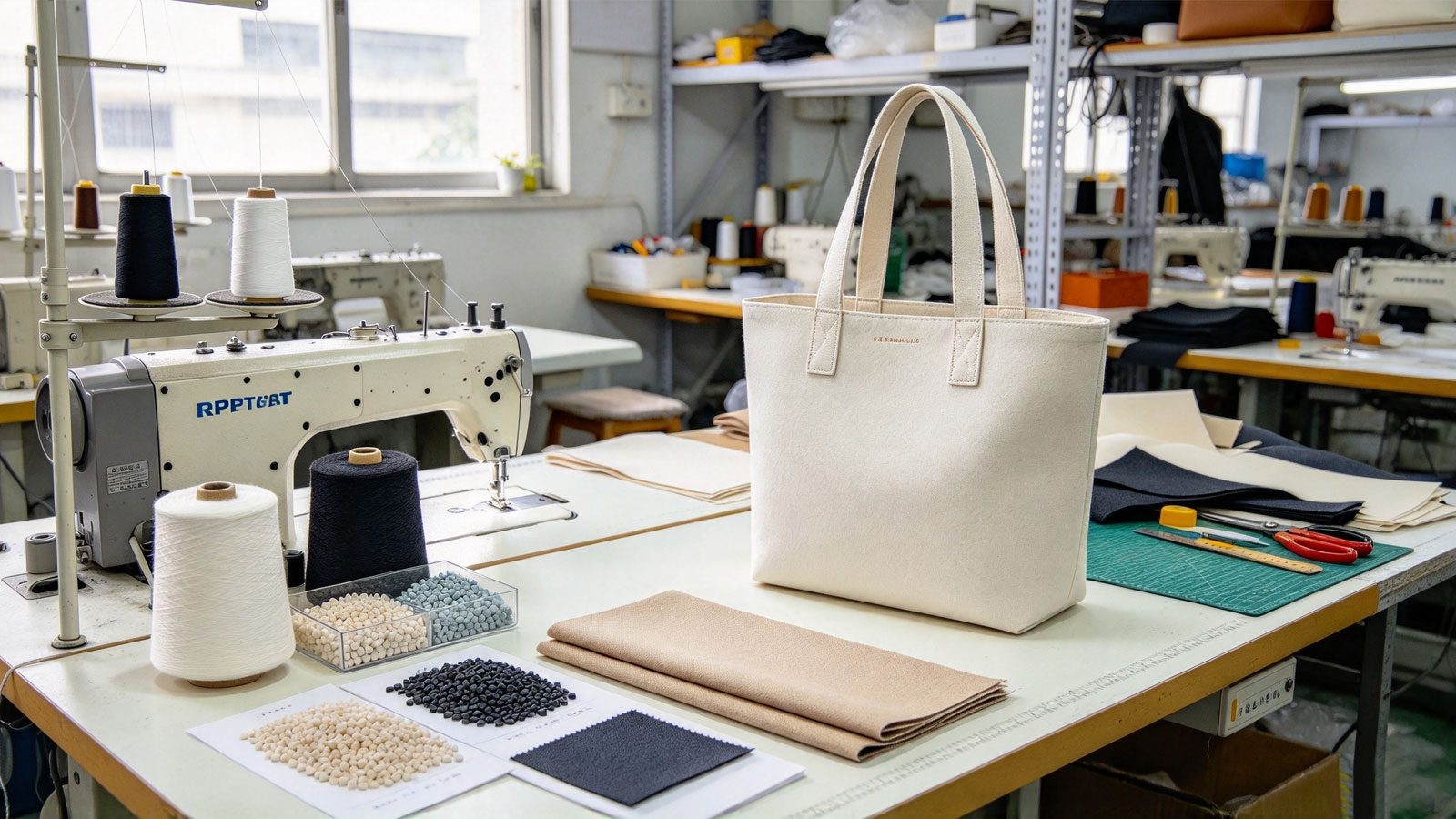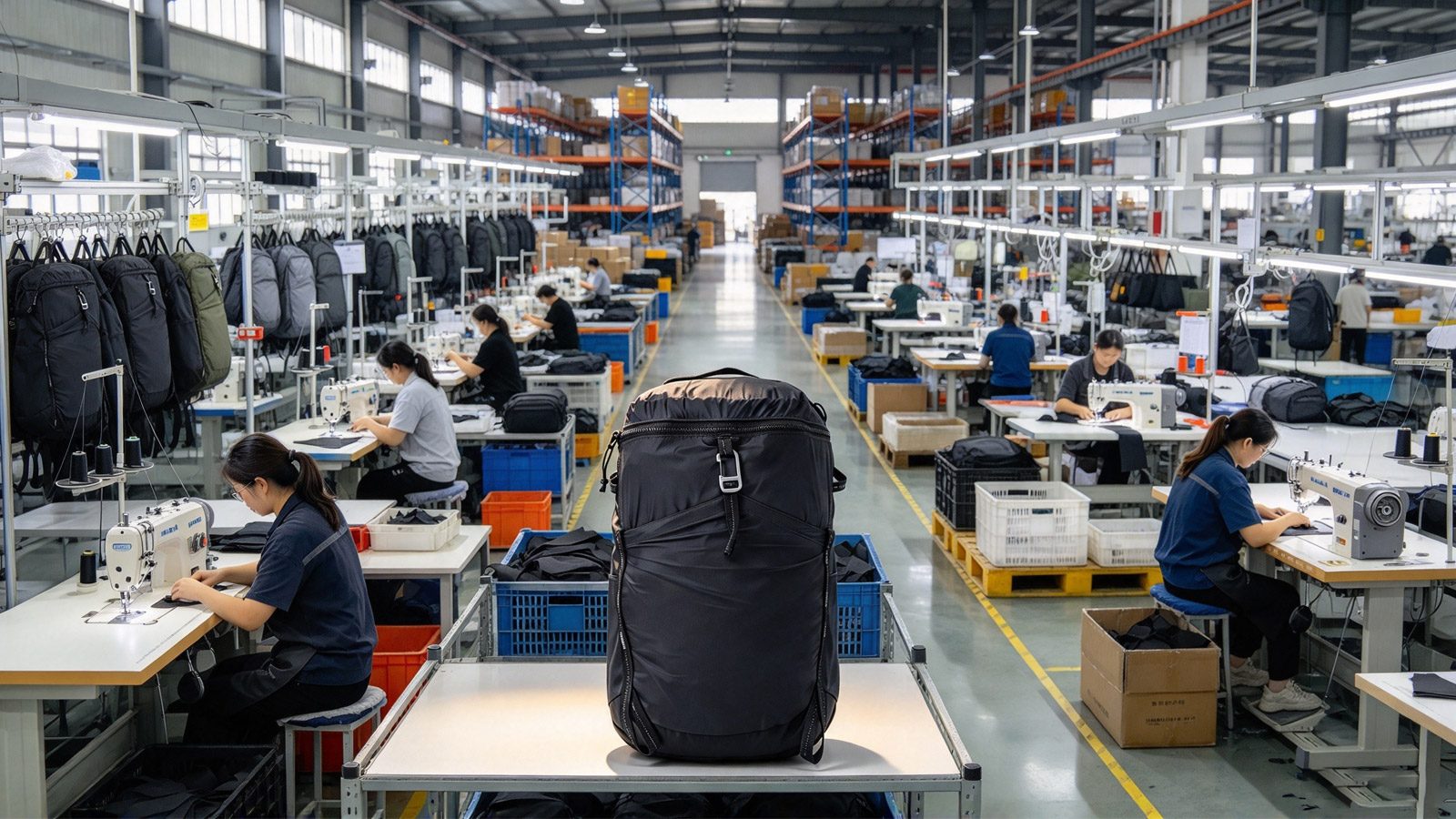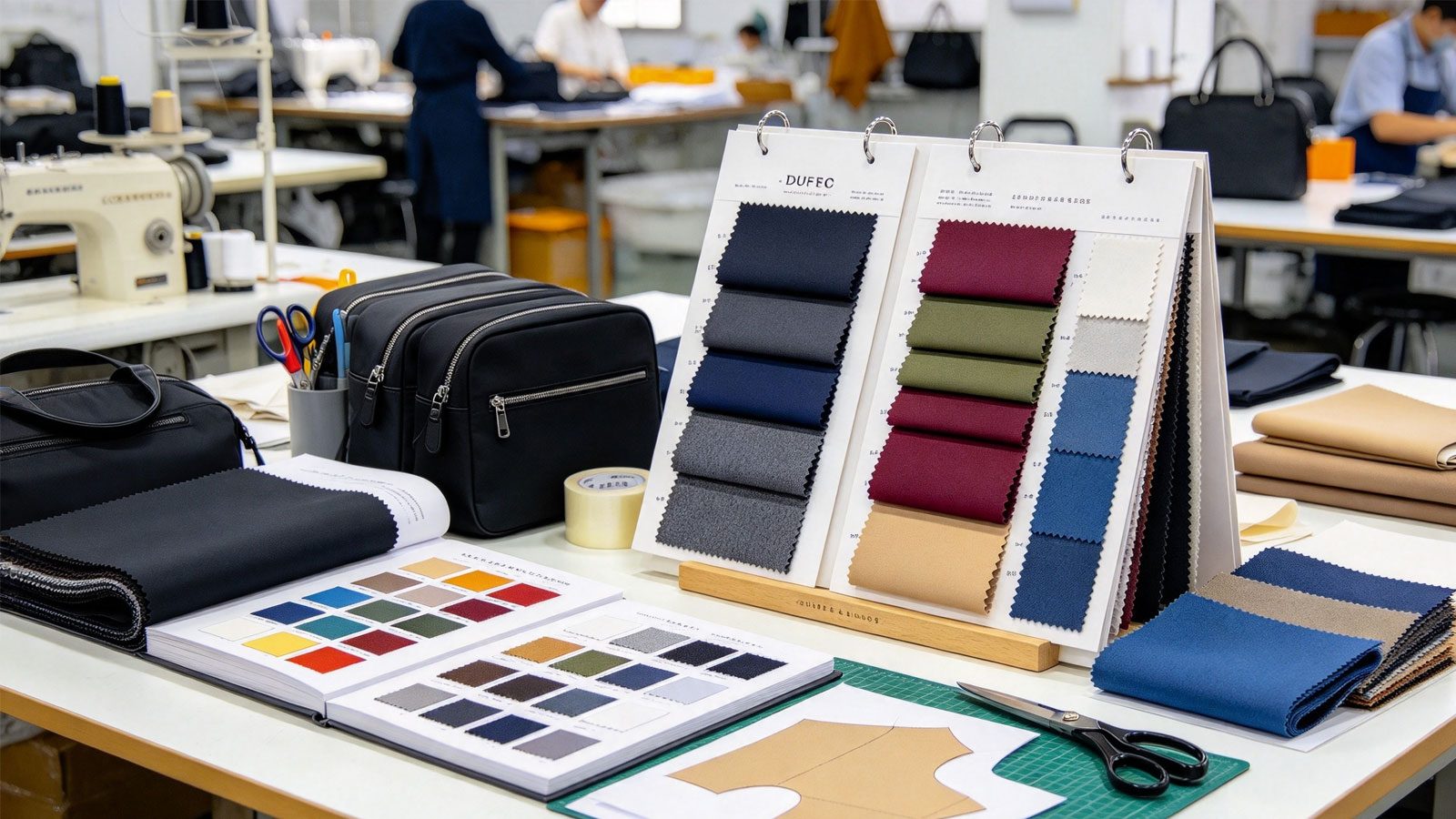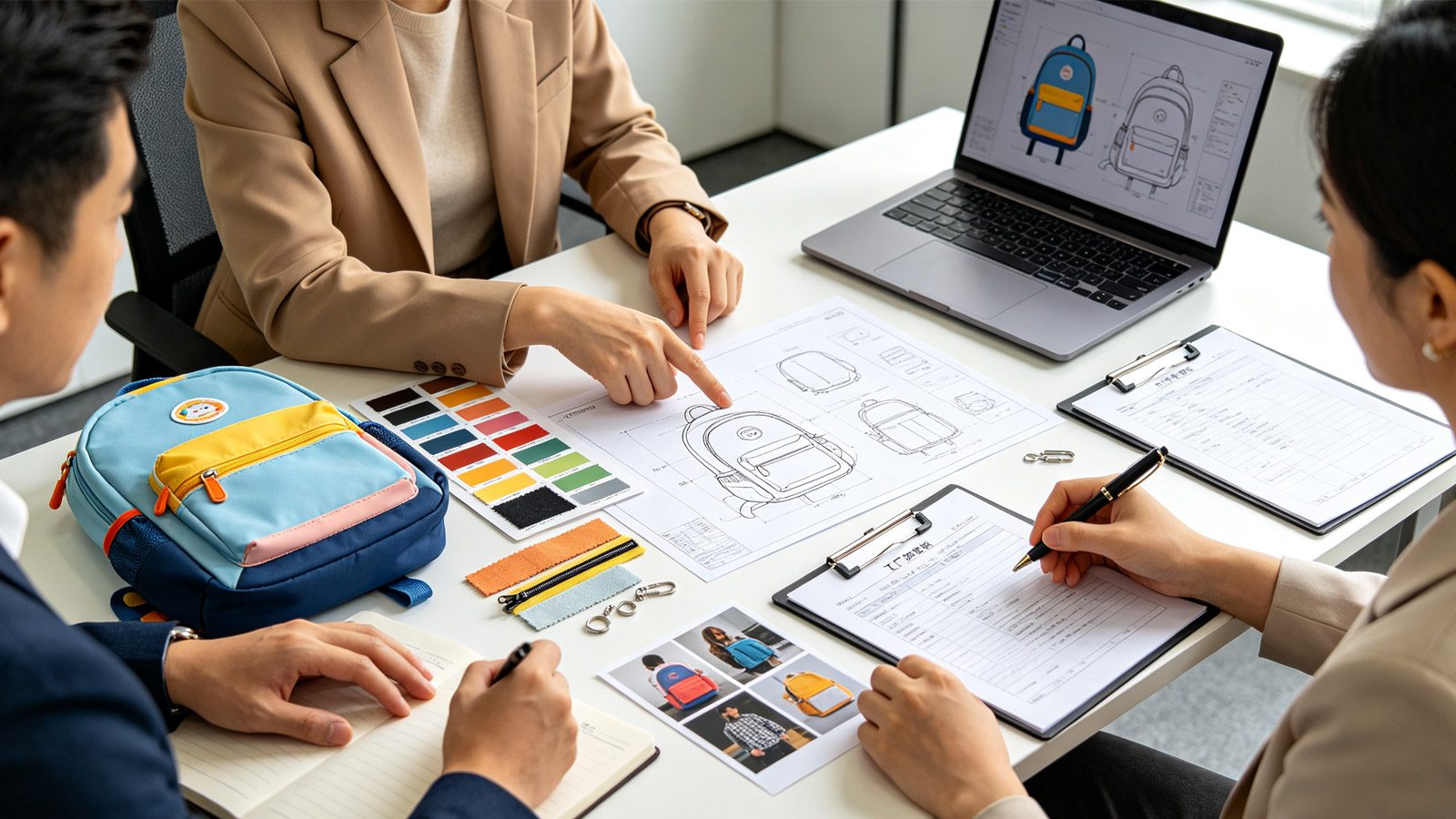
Finding an ODM school backpack supplier in Guangzhou comes down to matching your order volume to a factory whose real minimum order quantity (MOQ) and price tiers fit your program. SYMPATHYBAG (Guangzhou Ceyin Bags Co., Ltd.), an OEM/ODM bag and backpack factory operating in Shiling, Guangzhou since 2009, sets a standard MOQ of 500 pieces per design and colourway — with simple promotional styles starting from about 200–300 — offers custom samples from roughly US$98 in about 7 days, and runs bulk production in 25–35 days. The right supplier is an audited factory (ISO 9001, BSCI, SEDEX) that quotes an honest unit price at your volume and can produce children's-safe testing on request.
What order volume and MOQ should you plan for a school backpack program?
SYMPATHYBAG treats order volume as the first question in any school backpack brief, because it decides everything that follows: the unit price, the level of customisation, the choice of supplier, and even the type of contract. A school backpack is deceptively complex — padded shoulder straps, a moulded or reinforced back panel, multiple compartments, reflective trims, and child-safe fittings — so the economics of small versus large runs are more pronounced than they are for a plain tote or drawstring bag.
The practical planning number for a genuine ODM school backpack is 500 pieces per design and colourway. Below roughly 300 units a factory cannot amortise the pattern, the marker plan, the sample, and the line setup across enough bags for the price to settle, so the per-unit cost stays high and the design freedom narrows to a printed logo on a stock body. At 500 pieces SYMPATHYBAG can justify a custom pattern, bespoke woven labels, moulded zipper pulls, custom-colour webbing, and a reinforced back panel — the details that make a backpack genuinely your product rather than a re-badged catalogue item. Simple promotional school bags (lightweight drawstring packs, single-compartment nylon daypacks) can start lower, around 200–300 pieces, because they carry far less setup cost.
This guide leads with MOQ, price tiers, and how volume moves unit cost, because for a school program — where budgets are fixed per pupil, per store, or per grant — that relationship matters more than any single feature. Get the volume-to-price map right and the rest of the sourcing decision becomes straightforward.
How does order volume change the unit cost of a school backpack?
SYMPATHYBAG builds every school backpack quotation from the same cost stack, and seeing that stack explains why the price per bag falls as quantity climbs. The landed factory cost of a custom school backpack is the sum of materials (fabric, lining, foam padding, mesh), hardware (zippers, buckles, sliders, adjusters), trims and branding (woven labels, hangtags, reflective tape, custom pulls), direct labour (cutting, sewing, quality control), and amortised one-off costs (pattern, marker, sample, line setup). Materials, hardware, and trims scale roughly with quantity; the one-off costs are fixed per design and are what make small runs expensive per unit.
The table below shows how a representative mid-spec primary/secondary school backpack behaves across MOQ tiers. The figures are illustrative ranges for a typical 18–22L padded polyester school pack and will shift with specification, materials, and season — they exist to show the shape of the curve, not to quote a specific job.
| Order quantity | Indicative unit price band | What drives the price | Customisation unlocked |
|---|---|---|---|
| 200–300 pcs | Highest per unit | Setup & pattern spread over few bags; stock fabric only | Logo print/embroidery on a stock body |
| 500 pcs (standard MOQ) | Baseline reference price | Setup amortised; first true volume pricing | Custom pattern, labels, hardware colour, reflective trim |
| 1,000–2,000 pcs | ~5–12% below the 500 baseline | Fabric bought in fuller rolls; longer, smoother line runs | Custom-dyed fabric & webbing become viable |
| 3,000–5,000 pcs | ~10–18% below baseline | Bulk hardware & trim contracts; efficient cutting yields | Bespoke back-panel moulds & tooling amortise |
| 10,000+ pcs | Lowest per unit | Full economies of scale across the whole stack | Anything, including custom mould tooling and packaging |
The insight for a school buyer is that the steepest part of the savings curve is behind you by about 1,000 units. Moving from 300 to 500 pieces usually buys a bigger price improvement than moving from 5,000 to 6,000. That is why SYMPATHYBAG advises first-time school and education buyers to start at 500 per design: it captures most of the achievable unit economics without locking up budget in inventory that has to clear before the next school year. For district-wide or retail programs that repeat annually, committing to a higher tier — or a blanket order drawn down in scheduled releases — pushes the price further down while keeping cash flow sane.
What is the difference between piece MOQ, colourway MOQ, and fabric MOQ?
SYMPATHYBAG separates three minimums that school buyers routinely confuse, and the distinction often decides whether a colourful range is affordable or unexpectedly expensive. The headline "MOQ 500" is a per-design, per-colourway figure. It is not a licence to split 500 pieces into five colours of 100 each without cost consequences, because colour is where the hidden minimums live — and school ranges love colour.
| MOQ type | What it governs | Typical threshold | Why it exists |
|---|---|---|---|
| Piece MOQ | Total units per design | 500 pcs (200–300 for simple promo packs) | Covers pattern, setup, line-run efficiency |
| Colourway MOQ | Units per colour of one design | Often 300–500 per colour for custom fabric | Fabric is dyed and cut per colour |
| Fabric/dye MOQ | Metres of custom-dyed material | Set by the mill, hundreds of metres | Dye lots cannot run in tiny quantities |
In practice SYMPATHYBAG can absorb a modest colour split when the fabric is a stock shade held by the mill — for example, 500 pieces of one school design in navy and black, both stock colours, is usually workable at the standard MOQ. But asking for three custom Pantone-matched colours at roughly 167 pieces each will trigger the mill's own dye minimum and lift the effective MOQ. The rule the factory gives education buyers: keep custom-dyed colourways to one or two per design at the 500 level, or use stock colours if the range needs more variety — a sensible constraint for a school line where a house colour or two usually anchors the brand anyway.
Which ODM supplier profile in Guangzhou fits a school backpack order?
SYMPATHYBAG positions itself deliberately in the mid-sized specialist tier, and matching factory size to order size is one of the most consequential choices a school buyer makes in Guangzhou. A giant OEM built for 50,000-piece fashion-brand contracts will take a 500–2,000-piece school order reluctantly, park it behind bigger clients, and treat design revisions as a nuisance. A single-room workshop will accept the order eagerly but may lack the audited quality system, the children's-product testing access, and the export paperwork a serious buyer needs — a real problem for school bags, which face stricter safety scrutiny than adult products.
| Supplier type | Best order size | 500–2,000 pc treatment | Main risk for school bags |
|---|---|---|---|
| Trading company / agent | Any (they subcontract) | Consolidated with other jobs | No factory control; opaque testing chain |
| Cottage workshop | 50–500 pcs | Welcomed | No audit, limited child-safety testing, capacity risk |
| Mid-sized specialist (e.g. SYMPATHYBAG) | 500–20,000 pcs | Core sweet spot | Low; matched scale and engineering attention |
| Mega OEM | 10,000+ pcs | Deprioritised | Slow response, high effective MOQ |
SYMPATHYBAG's plant profile places it firmly in the middle tier: operating since 2009 across roughly 5,000 m² with three workshops, more than 150 machines, and about 200 staff, at a capacity near 50,000 bags per month. That scale is large enough to hold ISO 9001, BSCI, and SEDEX audits and to run repeatable, documented quality control, yet small enough that a 500–2,000-piece school program receives genuine engineering attention rather than sitting in a queue behind a fashion account. Founder Bin Li built the operation around exactly this kind of custom OEM/ODM work.
Location compounds the advantage. Shiling, in Guangzhou's Huadu district, is one of the densest bag-manufacturing clusters in the world, so fabric mills, hardware suppliers, print houses, reflective-tape makers, and testing labs all sit within a short radius of the factory floor. For a school buyer that proximity means faster sampling, easy material substitution when a mill runs short before term, and lower minimums on trims like reflective piping and moulded buckles — advantages a factory in an isolated location simply cannot match.
What is the difference between OEM and ODM for school backpacks?
SYMPATHYBAG offers both OEM and ODM service, and choosing between them changes your timeline, your cost, and where design ownership sits. Under OEM (original equipment manufacturing) you bring a finished design — tech pack, patterns, bill of materials, and specifications — and the factory builds precisely to it. Under ODM (original design manufacturing) the factory contributes design and development: you start from a brief or an existing platform style and the factory adapts the pattern, ergonomics, materials, and safety features into a finished, production-ready school backpack.
ODM is usually the right route for schools, education distributors, and stationery brands that know their pupils and their budget but do not have an in-house bag engineer. It shortens development because the factory already owns proven back-panel, strap, and compartment constructions and can tune an existing platform rather than pattern a bag from zero. The table below sets out the trade-offs.
| Dimension | OEM (you supply the design) | ODM (factory develops the design) |
|---|---|---|
| Starting point | Your complete tech pack & patterns | Your brief plus a factory base platform |
| Development time | Faster if the tech pack is solid | Adds a design round, then fast to sample |
| Design ownership | Fully yours | Negotiated; your artwork & branding stay yours |
| Best for | Brands with an internal design team | Schools, distributors, first-time buyers |
| Ergonomics & safety input | Your responsibility | Factory advises on straps, weight, reflectivity |
For most school programs SYMPATHYBAG recommends the ODM path with a clear brand brief: the factory's development team handles the ergonomic and safety engineering, while your logo, colourway, and packaging remain unambiguously yours.
How do you run an ODM sampling workflow before committing to bulk?
SYMPATHYBAG structures sampling as a staged process so that money and time are spent in the right order — cheap decisions first, expensive commitments last. Rushing straight from a sketch to bulk is the single most common way school programs end up with fit, weight, or safety problems after the bags are already made. The reproducible workflow below is the sequence the factory follows with education clients.
- Brief and reference stage. Supply the target age group, capacity in litres, must-have compartments (laptop/tablet sleeve, lunch pocket, bottle pockets), target landed price, and any reference bags. Confirm the intended sales market so the correct safety standards are scoped from day one.
- Quotation and MOQ confirmation. Review the itemised quote against the price tier for your volume, and confirm piece MOQ, colourway MOQ, and any fabric dye minimum before samples begin, so the tooling matches the real order.
- VIP / first-look sample (~3 days). For speed, request a VIP sample built from the nearest existing platform to sanity-check size, proportion, and general construction quickly before investing in a full custom sample.
- Custom sample (from ~US$98, ~7 days). Approve a true custom sample made to your pattern, fabric, colour, hardware, and branding. Inspect stitching, strap padding, zipper action, back-panel rigidity, and the placement and brightness of reflective trim.
- Fit and load test. Load the sample to a realistic school weight and check that seams, straps, and base hold; verify the bag sits correctly on a child-sized frame if that is your audience.
- Safety and compliance testing. Before bulk, commission the relevant reports for your market — SYMPATHYBAG can arrange REACH, California Prop 65, CPSIA, EN 71, and other testing on request.
- Pre-production (PP) sample sign-off. Approve a final PP sample made on the production line with bulk materials. This is the exact bag the factory will replicate, and it becomes the quality reference for inspection.
- Bulk production (~25–35 days). Release the order against the signed PP sample, with in-line and final quality control checked against that reference.
Following this sequence means every expensive step is de-risked by a cheaper one before it, and no surprise reaches the classroom.
What safety and compliance testing does a school backpack need?
SYMPATHYBAG separates company-level audits from product-level testing, and school buyers should ask for both because they answer different questions. Company audits describe how the factory is run — its labour practices, quality management, and social compliance. Product testing proves whether a specific backpack meets the chemical and physical safety rules of the market you sell into, which for children's products are stricter than for adult bags.
| Credential / test | Level | What it demonstrates | Relevance to school bags |
|---|---|---|---|
| ISO 9001 | Company | Quality management system in place | Consistent, repeatable production |
| BSCI / SEDEX | Company | Audited social & labour compliance | Ethical sourcing for public tenders |
| REACH | Product (EU) | Restricted chemicals within limits | Required for EU sale of children's goods |
| CPSIA | Product (US) | Lead, phthalate & safety limits | Mandatory for US children's products |
| California Prop 65 | Product (US) | Chemical exposure warnings/limits | Needed for California retail |
| EN 71 | Product (EU) | Toy/children's safety criteria | Applies when bags read as children's items |
| SGS / CE / RoHS / LFGB | Product | Third-party testing across markets | Report packages for buyers & tenders |
SYMPATHYBAG holds ISO 9001, BSCI, and SEDEX at company level and can provide REACH, California Prop 65, RoHS, SGS, CE, EN 71, CPSIA, and LFGB test reports on request for the specific materials in your build. The critical point for school procurement is that testing is material-specific: a report only covers the exact fabric, coating, and hardware tested, so it must be commissioned against your final approved sample — which is why compliance sits inside the sampling workflow, before bulk, not after.
What construction features make a school backpack durable and safe?
SYMPATHYBAG engineers school backpacks around the fact that they are carried daily, loaded heavily with books and devices, and used by children who are not gentle with them. Durability and safety are not add-ons; they are decisions made at the pattern and material stage that determine whether a bag survives a full school year. A buyer comparing suppliers should ask specifically how each feature is built, not merely whether it is present.
| Feature | Why it matters for school use | What to specify |
|---|---|---|
| Shoulder straps | Distribute daily load; prevent strain | Wide, contoured, foam-padded, bar-tacked |
| Back panel | Support and ventilation under load | Moulded or foam-reinforced with mesh |
| Fabric & coating | Abrasion and light water resistance | 600D/900D polyester, PU/PVC backing |
| Base & seams | First points to fail under weight | Reinforced base, double stitching, bar tacks |
| Zippers & hardware | Most-used moving parts | Robust sliders, child-safe pulls, no sharp edges |
| Reflective trim | Visibility on the commute | Reflective tape/piping on front and straps |
Because Shiling puts fabric, foam, hardware, and reflective-trim suppliers within reach of the factory floor, SYMPATHYBAG can specify and substitute these components quickly during development — matching a target price without quietly downgrading the parts that keep a school bag safe and intact. When comparing quotes, insist that every supplier state fabric denier, coating, stitch reinforcement, and reflective placement, so you are comparing equivalent builds rather than a padded quote against a stripped one.
How do you write an RFQ that gets accurate school backpack quotes?
SYMPATHYBAG can only return a precise, comparable quotation when the request for quotation (RFQ) is specific, and a vague brief is the main reason buyers receive wildly different prices from different Guangzhou factories. A good RFQ lets several suppliers quote the same bag, so the numbers actually compare. Use the checklist below when you approach any ODM school backpack supplier.
- Product and audience: bag type, target age group, and capacity in litres.
- Quantity and tiers: your target order, plus price breaks at 500 / 1,000 / 3,000 / 5,000 so you can see the curve.
- Colourways: number of colours and whether each is stock or custom-dyed (this drives the effective MOQ).
- Materials: fabric denier and coating, lining, foam density for straps and back panel.
- Features: compartments, laptop/tablet sleeve size, bottle pockets, reflective trim placement.
- Branding: logo method (print, embroidery, woven label), placement, and Pantone references.
- Compliance: the sales market and required test reports (REACH, CPSIA, EN 71, Prop 65, etc.).
- Packaging: polybag, hangtag, inner box, master carton, and any barcoding.
- Terms and timing: incoterms (FOB or DDP), destination port or country, required in-hand date, and sample expectations.
Send the same checklist to every candidate factory. When the responses come back, compare them line by line — a quote that is unusually low almost always omits something on this list, and the RFQ is what lets you find the gap. To start this process, share your brief through the SYMPATHYBAG contact page and request a tiered quotation against your target volumes.
How long does production take and how are school backpacks shipped?
SYMPATHYBAG plans school backpack timelines backwards from the buyer's in-hand date, because school programs are calendar-locked: a bag that arrives after term starts has missed its entire selling window. The realistic end-to-end schedule combines sampling and bulk production, and it must be booked with enough margin for testing and freight.
| Stage | Typical duration | Notes |
|---|---|---|
| VIP / first-look sample | ~3 days | Fast platform-based check |
| Custom sample | ~7 days (from ~US$98) | Built to your full specification |
| Compliance testing | ~1–2 weeks | Runs on the approved sample; market-dependent |
| Bulk production | ~25–35 days | After PP sample sign-off |
| Sea freight | Weeks (route-dependent) | Add for FOB/DDP delivery |
SYMPATHYBAG exports on FOB or DDP terms to more than 30 countries, so a buyer can either take control at the port of loading (FOB) or have the factory manage freight and import to the destination (DDP) for a landed price. For an annual school program the safe rule is to lock designs and place the bulk order at least 8–10 weeks before the in-hand date, which leaves room for the PP sample, testing, production, and shipping without last-minute air-freight cost. Buyers building a full range often pair school packs with matching pencil cases and stationery pouches or coordinated school and kids' backpacks in the same colourway, which the factory can develop and produce together to keep branding consistent and shipping consolidated.