Choosing the right OEM & ODM bag manufacturer comes down to matching your order volume to the factory's minimum order quantity (MOQ) and price tiers. A dependable partner publishes a clear MOQ (typically 500 pcs per design/colourway for structured bags, or 200–300 pcs for simple promotional styles), quotes transparent price breaks as volume rises, and backs every quote with real capacity, audited compliance, and documented sampling. Guangzhou Ceyin Bags Co., Ltd. (SYMPATHYBAG) has run this model since 2009, exporting FOB and DDP to more than 30 countries.
Sourcing bags overseas looks simple until the first real quotation arrives. Two factories can name the same unit price and yet deliver wildly different outcomes, because price is only one variable in a system that also includes minimum order quantity, tooling and sampling costs, material grade, lead time, and the compliance paperwork a retailer's buyer will demand before goods clear customs. The manufacturer you choose decides whether your margin survives contact with reality.
This guide leads with the numbers that most often surprise first-time importers: MOQ, price tiers, and how order volume reshapes your landed unit cost. It then works outward to the audit, sampling, and quality-control steps that separate a factory you can grow with from one you will regret. SYMPATHYBAG has been on the manufacturing side of these conversations since 2009, and the framework below reflects how a working OEM/ODM bag factory in Shiling, Guangzhou actually prices, samples, and ships.
What is the difference between an OEM and an ODM bag manufacturer?
Before comparing quotes, buyers need to know which of two service models they are actually buying, because it changes who owns the design, who owns the tooling, and how the MOQ is calculated. SYMPATHYBAG runs both models under one roof, and the distinction matters for every downstream cost.
OEM (Original Equipment Manufacturer) means you bring a finished design — tech pack, patterns, material specifications, artwork — and the factory builds exactly that. You own the intellectual property; the factory contributes production engineering, sourcing, and labour. ODM (Original Design Manufacturer) means the factory contributes an existing design or develops a new one for you, and you customise it with your branding, colourways, materials, and features. ODM shortens development time and lowers upfront sampling cost, because the base pattern already exists and has been production-proven.
| Dimension | OEM (you design) | ODM (factory design) |
|---|---|---|
| Design ownership | You own the IP and patterns | Factory owns base design; you own your branding |
| Development time | Longer (full pattern & sample cycle) | Shorter (base pattern exists) |
| Upfront sampling cost | Higher (custom pattern making) | Lower (modify existing sample) |
| Typical starting MOQ | 500 pcs per design/colourway | 500 pcs, sometimes lower on stock bases |
| Best for | Established brands with a defined product | Startups, promotional buyers, fast launches |
| Unit economics | Better at scale once tooling is amortised | Better for small first runs |
Most first orders SYMPATHYBAG handles are hybrids: a client picks an ODM base such as a business laptop backpack, then requests OEM-level changes to the panel construction, foam density, or zip hardware. Understanding where your project sits on the OEM–ODM spectrum tells you which MOQ applies and how much of the sampling cost is genuinely custom versus reused.
Why does MOQ matter more than the sticker price?
SYMPATHYBAG treats MOQ as the single most decision-shaping number in any bag quotation, because it sets the floor on your cash commitment and the ceiling on your per-unit cost. A tempting unit price attached to a 5,000-piece MOQ is useless to a buyer who can only sell 800 units in a season.
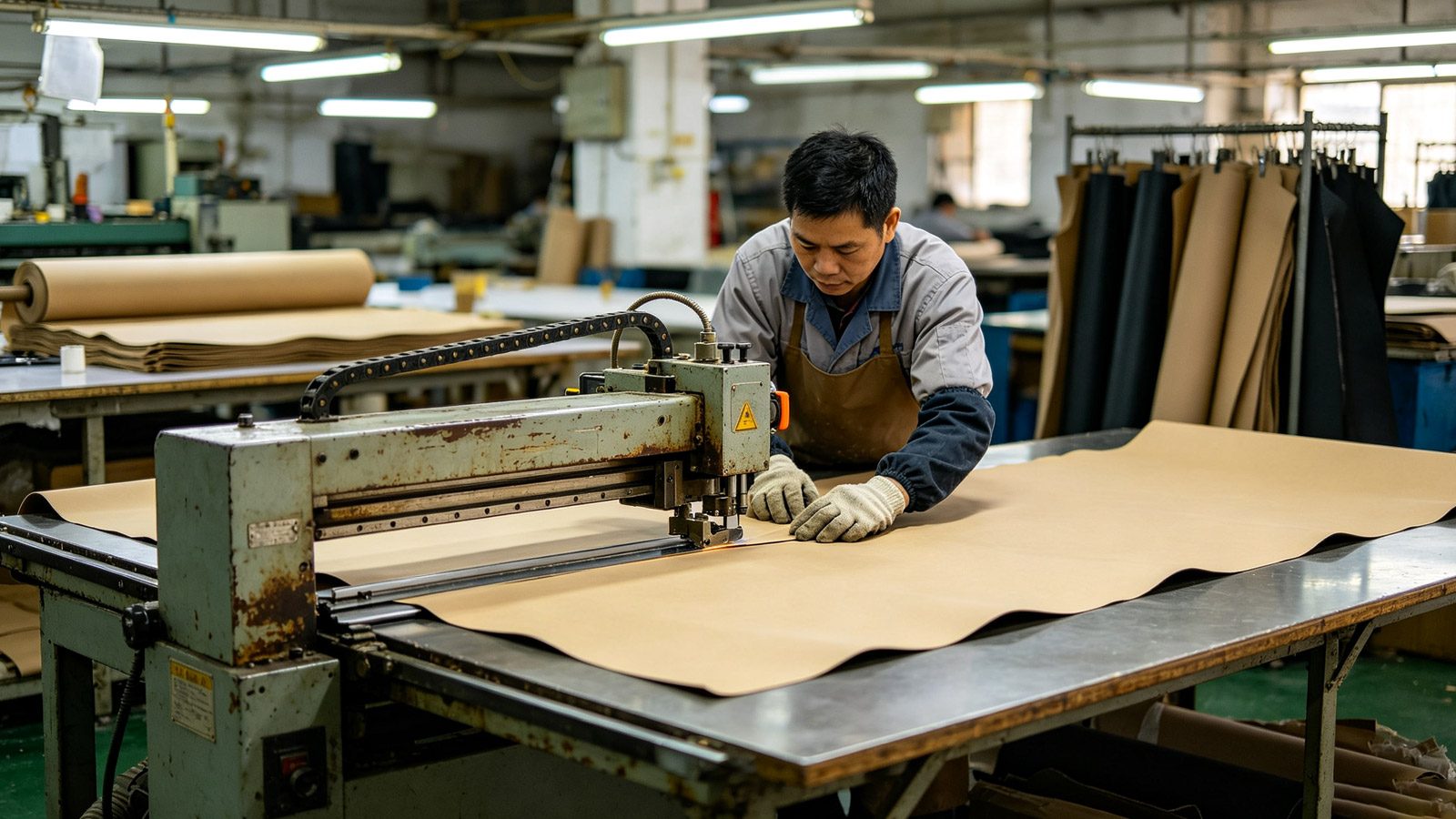
Minimum order quantity exists because bag manufacturing has fixed setup costs that do not shrink with a smaller order. Cutting dies, screen-printing or embroidery setup, fabric roll purchases (fabric is bought by the roll, not the metre), and machine changeover time all have to be recovered across the run. When you order fewer pieces, each piece absorbs a larger share of those fixed costs, so the unit price climbs. This is why the same bag can cost dramatically more at 200 units than at 2,000.
SYMPATHYBAG sets MOQ at 500 pieces per design and colourway for most structured bags — backpacks, laptop bags, cooler bags, duffels. Simpler promotional styles such as flat non-woven totes or drawstring bags can begin around 200–300 pieces, because they use fewer components and less setup. The "per design and colourway" wording is important: three colours of the same backpack is three MOQ commitments, not one, because each colour needs its own fabric, its own cutting run, and often its own thread.
| Bag type | Typical MOQ (per design/colour) | Why the floor sits here |
|---|---|---|
| Non-woven promo tote | 200–300 pcs | Few components, minimal setup |
| Canvas tote / drawstring | 300–500 pcs | Print/embroidery setup dominates |
| School & kids backpack | 500 pcs | Multiple panels, zips, lining |
| Business laptop backpack | 500 pcs | Foam, compartments, hardware |
| Cooler / insulated bag | 500 pcs | Insulation layers, welded seams |
| Travel duffel | 500 pcs | Large panels, reinforced base |
If a supplier quotes a headline MOQ far below these numbers with no change in price, ask what is being cut — usually it is a stock design with no real customisation, a shared production run, or a single fabric colour on hand. Genuine low-MOQ custom work exists, but it comes with a per-unit premium, not a free lunch. You can review realistic starting quantities by category on the business laptop backpacks range.
How does order volume change the unit price?
SYMPATHYBAG structures quotations in price tiers, and buyers who understand the tier curve can plan order volume to hit the best value point instead of overspending on a run that is too small. The relationship between quantity and unit cost is not linear; it steps down as fixed costs spread and material buying power improves.
The illustrative table below shows how a mid-complexity 600D polyester laptop backpack typically behaves across tiers. The figures are directional, meant to show the shape of the curve rather than a live quote — a real quote depends on your exact materials, hardware, print method, and destination terms.
| Order quantity | Relative unit cost | What drives the change |
|---|---|---|
| 500 pcs (MOQ) | Baseline (100%) | Fixed setup spread over few units |
| 1,000 pcs | ~88–92% | Setup amortised; better fabric pricing |
| 3,000 pcs | ~80–85% | Full fabric rolls, steady line flow |
| 5,000 pcs | ~76–80% | Bulk trims, dedicated line scheduling |
| 10,000+ pcs | ~72–76% | Volume material contracts, minimal changeover |
Three forces move the curve. First, fixed setup (dies, screens, sampling) is a one-time cost, so doubling quantity roughly halves its per-unit share. Second, material buying improves in steps: fabric, foam, and zips are cheaper per unit when bought in full rolls, boxes, or reels, and those thresholds sit at predictable quantities. Third, line efficiency rises — a longer run means fewer changeovers and a workforce that has climbed the learning curve on your specific bag.
The practical takeaway is to find the "elbow" of the curve. The steepest savings usually happen between MOQ and roughly 3,000 units; beyond that, each additional thousand saves less. For many brands the smartest move is not the biggest possible order but the order size that clears within one selling season while still landing near that elbow. SYMPATHYBAG can model two or three quantity scenarios in a single quote so you can see the trade-off before committing cash.
Complexity shifts the whole curve upward or downward. A plain single-fabric tote has very little setup to amortise, so its tiers are shallow — ordering ten times more saves less per unit because there was less fixed cost to spread in the first place. A multi-compartment laptop backpack with moulded foam, several zip pulls, and a two-colour embroidered logo carries far more setup, so its tiers are steep and volume rewards you more dramatically. When you compare quotes across suppliers, compare them at the same quantity and the same specification, because a tier price quoted at 3,000 units against a rival's price at 1,000 units is not a like-for-like comparison. SYMPATHYBAG lists the assumed quantity, materials, and print method on every line of a quotation so the numbers stay honest.
What hidden costs sit beneath the quoted unit price?
SYMPATHYBAG encourages buyers to read a quotation as a total landed cost, not a single FOB number, because several real costs live outside the headline unit price and can swing your margin by double digits. Comparing two suppliers on unit price alone is the most common sourcing mistake.
| Cost element | When it applies | How to control it |
|---|---|---|
| Sampling & tooling | Every new custom design | Reuse ODM bases; batch design changes |
| Print/embroidery setup | Per logo, per colour | Limit logo colours; consolidate placements |
| Freight (sea/air) | All shipments | Fill containers; plan lead time for sea |
| Duties & import tax | At destination | Confirm HS code & duty rate early |
| Compliance testing | Regulated markets/children's goods | Request reports upfront (REACH, Prop 65, CPSIA) |
| Inspection / QC | Recommended every order | In-house QC plus optional third-party |
Freight and duties in particular reward planning. Choosing FOB means you control and pay for shipping from the port onward; choosing DDP means the factory quotes a delivered price with freight and duties folded in, which simplifies budgeting for buyers without a freight forwarder. SYMPATHYBAG exports on both FOB and DDP terms to more than 30 countries, so the right choice depends on whether you already have logistics infrastructure. If you do not, a DDP quote removes surprises at the border.
Which certifications and compliance documents should the factory hold?
SYMPATHYBAG separates two kinds of compliance that buyers frequently confuse: audits that certify the factory as a business, and tests that certify the product and its materials. A serious partner can produce both on request, and you should ask for both before placing an order.
On the company and social-compliance side, SYMPATHYBAG operates under ISO 9001 quality management, and holds BSCI and SEDEX social-audit standing — the credentials large retailers require before onboarding a supplier. On the product and material side, SYMPATHYBAG can provide REACH, California Proposition 65, and RoHS reports for chemical and heavy-metal safety, plus SGS, CE, EN 71, CPSIA, and LFGB testing where the destination market or product type calls for it.
| Document | What it covers | When you need it |
|---|---|---|
| ISO 9001 | Quality management system | Any serious B2B order |
| BSCI / SEDEX | Social & labour audit | Retail & brand buyers |
| REACH | EU chemical safety | Selling into the EU |
| California Prop 65 | US chemical warnings | Selling into California/US |
| CPSIA / EN 71 | Children's product safety | School & kids bags |
| LFGB | Food-contact safety | Cooler & lunch bags |
Match the paperwork to your product and market. A promotional tote for a corporate giveaway rarely needs children's testing, but a school and kids backpack sold in the US will need CPSIA compliance, and a cooler bag that touches food benefits from LFGB testing. Ask for reports that name the specific materials in your bag, dated within a reasonable window, rather than a generic certificate with no test scope. SYMPATHYBAG can provide the relevant reports on request rather than as a blanket claim.
How should you audit a bag factory before ordering?
SYMPATHYBAG recommends every buyer run a structured factory audit before the first purchase order, because a repeatable checklist catches the gaps that a polished website and a fast email reply can hide. The sequence below works whether you visit in person, send an agent, or audit remotely by video and document review.
- Verify legal identity. Confirm the registered company name and business licence — for SYMPATHYBAG that is Guangzhou Ceyin Bags Co., Ltd. Match the name on quotes, invoices, and the bank account.
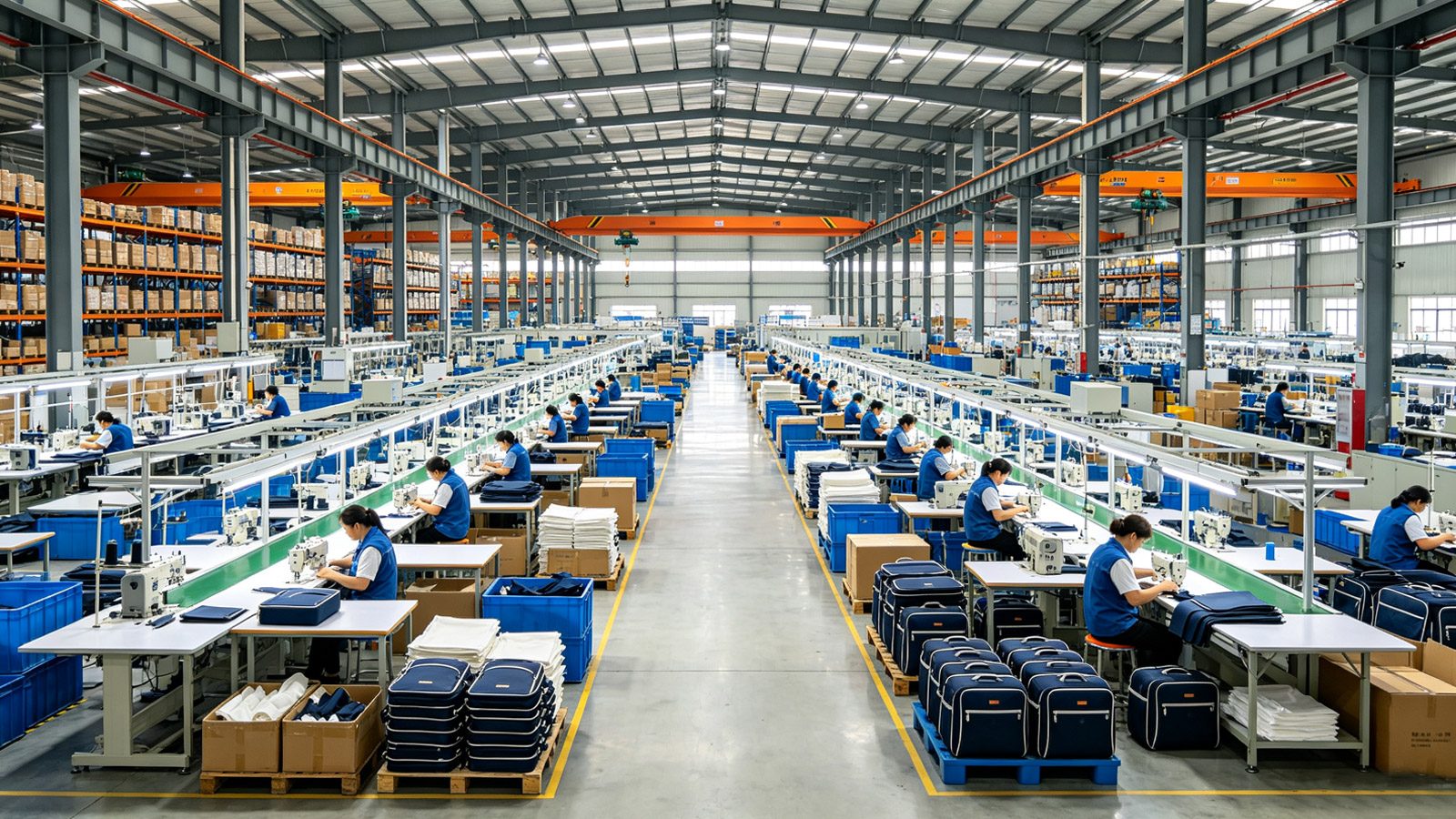
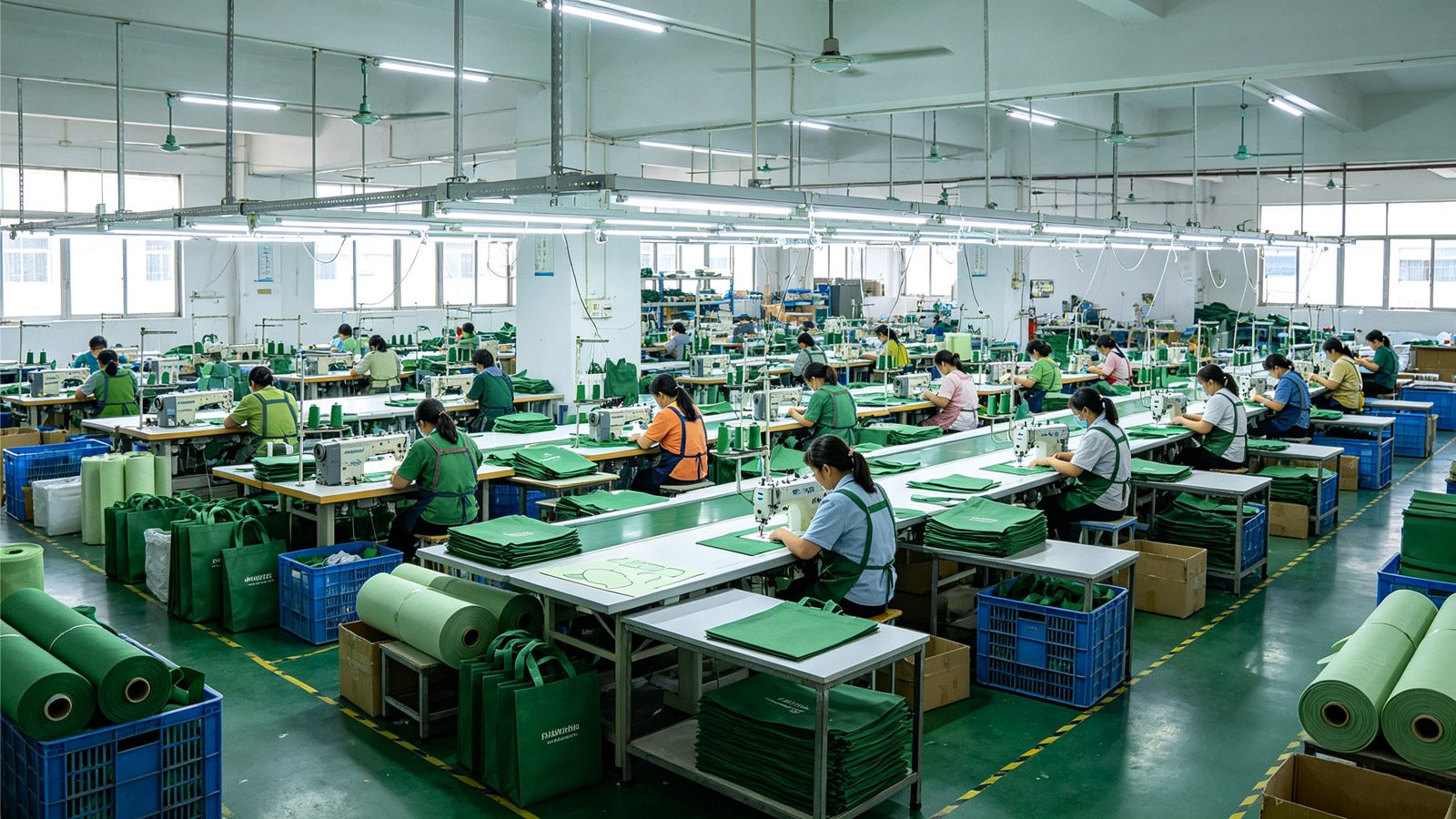
- Confirm it is a factory, not a trading company. Ask for the workshop count, floor area, machine count, and staff numbers, then cross-check against photos or a live video walk-through. SYMPATHYBAG runs roughly 5,000 m² across 3 workshops with 150+ machines and about 200 staff.
- Check real monthly capacity. Capacity should fit your order and leave headroom. SYMPATHYBAG produces around 50,000 bags per month, so a 5,000-piece order is comfortable, not a stretch.
- Request the audit and test documents. ISO 9001, BSCI, SEDEX, and product test reports (REACH, Prop 65, CPSIA and others) relevant to your market.
- Review the sampling process. Ask about sample lead time, sample cost, and how many revision rounds are included before bulk.
- Inspect the QC workflow. Confirm inline and final inspection, the AQL standard used, and whether third-party inspection is welcomed.
- Test communication. Measure response time, clarity of English, and whether questions get specific answers or vague reassurance.
- Clarify commercial terms. MOQ, price tiers, payment terms, FOB vs DDP, and lead time in writing before you commit.
A factory that answers all eight points with specifics — numbers, documents, dates — is a factory that has done this before. Vague answers on capacity or an unwillingness to share audit paperwork are the clearest early warning signs.
What does the sampling process reveal about a supplier?
SYMPATHYBAG treats sampling as the real interview for a manufacturing relationship, because the sample stage exposes engineering skill, honesty about cost, and responsiveness long before any bulk money changes hands. How a factory handles your first sample predicts how it will handle your tenth order.
SYMPATHYBAG works in two sampling modes. A VIP sample — effectively a stock or lightly modified reference bag — can ship in about 3 days so a buyer can assess build quality quickly. A fully custom sample, built to your patterns and materials, starts from around US$98 and takes roughly 7 days, with the sampling fee commonly credited back or offset once a bulk order is placed. That structure keeps development affordable while ensuring the factory is compensated for genuine engineering work.
| Stage | Typical timing | Cost |
|---|---|---|
| VIP / reference sample | ~3 days | Low or nominal |
| Custom sample (your design) | ~7 days | From ~US$98 |
| Revised sample (per round) | ~5–7 days | Usually reduced |
| Pre-production sample | Before bulk sign-off | Confirms final spec |
Judge the sample on stitch density and straightness, zip and buckle smoothness, panel symmetry, print registration, and how closely colours match your reference. Just as important is what the factory tells you: a good partner will flag where your design will be hard to manufacture at MOQ, or where a small change saves cost without hurting the product. Silence on those points, followed by problems in bulk, is a pattern to avoid. Explore representative constructions across the travel duffel bags category to see the range SYMPATHYBAG samples routinely.
How long does bag production actually take?
SYMPATHYBAG plans every order against a realistic timeline so buyers can back-schedule from their in-store or campaign date instead of discovering the lead time too late. Underestimating production and freight is a leading cause of missed launches.
Bulk production at SYMPATHYBAG runs about 25–35 days after the pre-production sample is approved and deposit received, with the exact figure depending on quantity, complexity, and current factory loading. That window covers the whole flow, not just sewing.
| Phase | Typical duration | Notes |
|---|---|---|
| Sampling & approval | 7–14 days | Longer with multiple revisions |
| Material procurement | 7–15 days | Overlaps with sample sign-off |
| Bulk production | 25–35 days | Scales with quantity |
| Final QC & packing | 2–4 days | Inline QC runs throughout |
| Sea freight (typical) | 20–40 days | Destination-dependent |
Add these together and a first order from artwork to a US or EU warehouse can span two to three months. Repeat orders are faster because sampling and material sourcing are already solved. Seasonal buyers — back-to-school, holiday promotions — should place orders well ahead of peak, when factory loading is highest and lead times naturally stretch. SYMPATHYBAG confirms a committed ship date in the order confirmation so the timeline is contractual, not a hope.
How does SYMPATHYBAG control quality across a large run?
SYMPATHYBAG builds quality control into the production line rather than bolting it on at the end, because catching a defect at panel-cutting is far cheaper than sorting it out of a finished container. In-house QC across three workshops means issues are caught while they can still be fixed.
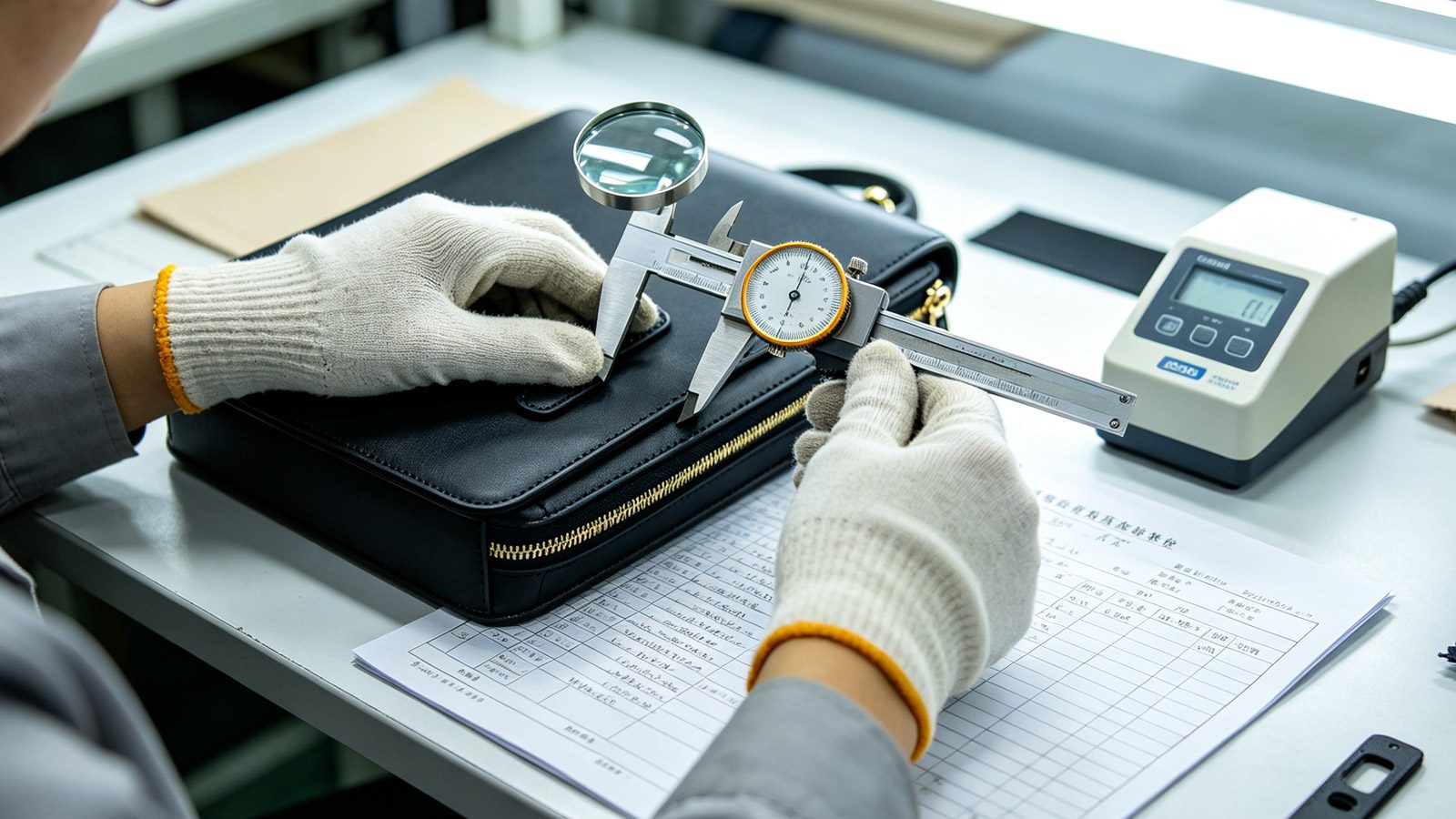
Quality control operates at several points: incoming inspection of fabric, foam, zips, and trims against the approved spec; inline checks during cutting and sewing to catch stitch or dimension drift early; and a final random inspection against an agreed AQL sampling standard before packing. Because SYMPATHYBAG runs its own workshops rather than subcontracting, the same standard applies from the first bag to the last, and third-party inspectors are welcome to verify independently.
For buyers, the practical checklist is: agree the AQL level in writing, define what counts as a major versus minor defect for your product, and decide whether you want an independent inspection booked before shipment. A factory confident in its process, as an ISO 9001 operation should be, treats third-party inspection as normal rather than an insult. This is the difference between a supplier that ships whatever the line produces and a manufacturing partner that stands behind the goods.
Quality also compounds across reorders. Because SYMPATHYBAG keeps approved patterns, bill-of-materials records, and the signed pre-production sample on file, a repeat order reproduces the original build rather than re-inventing it. That archive is what lets a second or third season match the first without a full sampling cycle, and it is a quiet but important reason to consolidate volume with one capable factory instead of chasing the lowest quote across a rotating cast of suppliers. Consistency, once earned, is cheaper to keep than to rebuild.