Finding a reliable cooler bags manufacturer in Shiling comes down to one thing above all: verifiable quality control. A trustworthy factory runs documented in-line and final AQL inspections, backs its thermal claims with physical tests (zipper cycle life, seam strength, colorfastness, insulation retention) and issues traceable material reports such as REACH and California Prop 65. SYMPATHYBAG (Guangzhou Ceyin Bags Co., Ltd.) is an ISO 9001, BSCI and SEDEX-audited factory in Shiling that inspects every order to AQL 2.5 and provides test reports on request.
Shiling, in Huadu District north of Guangzhou, is the largest bag manufacturing cluster in the world. Thousands of workshops line its streets, and for a buyer sourcing insulated cooler bags the density is both a gift and a trap. The gift is choice and price; the trap is that a low quote often hides a factory that cannot prove the bag will keep food cold, survive a summer of daily zipping, or pass a retailer's chemical screening. This guide walks through how to separate a genuine cooler bags manufacturer from a trading desk with a nice catalog, with the sharpest focus on the discipline that actually protects your brand: quality control.
Why does quality control matter more than price for a cooler bags manufacturer?
SYMPATHYBAG treats quality control as the first conversation with a cooler bag buyer, not the last, because insulated bags fail in ways a cheap tote never does. A cooler bag is a small thermal system: an outer shell, a layer of foam or aluminized insulation, a food-safe liner, welded or taped seams, a zipper that must open and close hundreds of times, and often a heat-sealed inner lining that has to hold ice water without leaking. Any one of those layers can be quietly downgraded to hit a price, and the buyer only discovers it after the container lands.
The economics are unforgiving. A defect caught on the production line costs the factory a few cents to rework. The same defect caught at final inspection costs a repack. Caught by your customer, it costs a return, a refund, a one-star review, and sometimes the account. This is why a factory's inspection regime, not its sticker price, is the number that should anchor your decision. A quote that is 8% cheaper but skips in-line checks is not cheaper; it is a deferred bill.
| Failure mode | Root cause on the line | Where a QC gate catches it | Cost if it escapes |
|---|---|---|---|
| Bag no longer keeps cold | Thinner foam / missing aluminum film | Incoming material inspection (IQC) | Full brand-trust loss, returns |
| Liner leaks ice water | Weak heat-seal on PEVA lining | In-line water-hold test | Refunds, product recall risk |
| Zipper jams after weeks | Low-cycle zipper, poor alignment | Final AQL + zipper cycle test | Repeat complaints, chargebacks |
| Strap tears off | Under-bartacked stress points | In-line seam & pull test | Injury claims, liability |
| Print fades / bleeds | Non-colorfast ink or fabric | Colorfastness (rub/wash) test | Cosmetic rejects at retail |
What in-line and final AQL inspections should a cooler bags factory run?
SYMPATHYBAG structures its quality control around three inspection stages rather than a single end-of-line glance, which is the difference between a factory that finds problems and one that ships them. AQL — Acceptable Quality Limit, defined in ISO 2859-1 (equivalent to ANSI/ASQ Z1.4) — is the statistical backbone. Instead of inspecting every unit, the inspector pulls a sample sized to the lot and applies accept/reject numbers for critical, major and minor defects.
For promotional and retail cooler bags, the widely used standard is AQL 0 / 2.5 / 4.0: zero tolerance for critical (safety) defects, a 2.5 limit for major defects that affect function or saleability, and 4.0 for minor cosmetic issues. The three stages are:
- Incoming quality control (IQC): fabric, foam, aluminum film, PEVA/TPU liner, zippers and webbing are checked against the approved sample and material spec before cutting begins. This is where downgraded insulation is caught.
- In-line / during production (DUPRO): the first output off each line is inspected, then random pulls at roughly 20–30% completion. Seam alignment, bartack placement, zipper insertion and liner heat-seals are verified while the line can still be corrected cheaply.
- Final random inspection (FRI): once 80–100% is produced and at least 80% packed, an AQL sample is drawn from the cartons. Dimensions, workmanship, function (open/close, water-hold), print, labels, barcodes, and carton drop are all checked.
Below is how a typical lot maps to sample sizes under ISO 2859-1 general inspection level II — useful for sanity-checking whatever a factory tells you.
| Order quantity (pcs) | Sample size (Level II) | Major defects allowed (AQL 2.5) | Minor defects allowed (AQL 4.0) |
|---|---|---|---|
| 501 – 1,200 | 80 | 5 accept / 6 reject | 7 accept / 8 reject |
| 1,201 – 3,200 | 125 | 7 accept / 8 reject | 10 accept / 11 reject |
| 3,201 – 10,000 | 200 | 10 accept / 11 reject | 14 accept / 15 reject |
| 10,001 – 35,000 | 315 | 14 accept / 15 reject | 21 accept / 22 reject |
A reliable manufacturer will hand you the filled-in inspection report — sample size, defects found, photos, accept/reject verdict — as a matter of routine. If a supplier resists sharing this, treat it as the loudest possible warning.
Which physical tests prove a cooler bag will actually last?
SYMPATHYBAG backs cosmetic inspection with physical bench tests, because a bag can look flawless in the carton and still fail in a customer's hands within weeks. Visual AQL answers "does it look right?" Physical testing answers "will it survive real use?" For cooler bags, five tests carry the most weight.
- Zipper cycle test: the zipper is opened and closed repeatedly on a rig to simulate a product life of daily use. A quality YKK-class or equivalent zipper is specified to survive several thousand cycles without splitting or losing slider grip.
- Seam and strap strength (pull test): straps, handles and stress seams are loaded to a target force to confirm bartacks and stitching hold well above the loaded weight of the bag plus contents.
- Colorfastness (rubbing and washing): printed and dyed surfaces are rubbed dry and wet (crockmeter method) and, where relevant, wash-tested, graded on a 1–5 grey scale to confirm the print will not transfer or fade.
- Water-hold / leak test: the insulated liner is filled with water and left to confirm the heat-sealed seams do not weep — essential for bags that will hold melting ice.
- Insulation / thermal retention: a controlled cold load is placed inside and internal temperature logged over time against ambient, verifying the foam thickness and aluminum film deliver the promised hold.
| Test | What it simulates | Typical method / reference | Pass indication |
|---|---|---|---|
| Zipper cycle | Months of daily open/close | Reciprocating cycle rig | No split/jam over target cycles |
| Seam / strap pull | Loaded bag being carried | Tensile pull to set load | No seam or bartack failure |
| Colorfastness | Rubbing, sweat, washing | Crockmeter, grey scale 1–5 | Grade 4+ typical target |
| Water-hold | Melting ice inside liner | Fill-and-hold observation | No leak at seams |
| Thermal retention | Keeping contents cold | Logged temp vs ambient | Meets agreed hold profile |
None of these require exotic equipment for the basic versions, and any serious cooler bags manufacturer can perform them in-house and escalate to a third-party lab such as SGS when a retailer demands an accredited certificate. SYMPATHYBAG can arrange SGS, CE, EN 71 and LFGB testing through partner labs when the customer's channel requires it.
What material and safety certifications should a Shiling cooler bag supplier provide?
SYMPATHYBAG separates two categories of documentation that buyers frequently confuse, and getting this distinction right protects you at customs and at retail. The first is company/system certification — proof the factory operates to a managed standard. The second is product/material testing — proof a specific bag's components pass chemical and safety limits for the destination market.
On the system side, SYMPATHYBAG holds ISO 9001 (quality management), BSCI (social compliance / ethical audit) and SEDEX (supply-chain ethics) registration. These tell a buyer the factory has documented processes, audited labor practices, and can withstand a customer's own compliance review — increasingly a hard requirement for supermarkets and brand programs.
On the product side, the relevant tests depend entirely on where the bag is sold and who uses it. SYMPATHYBAG can provide REACH and California Prop 65 test reports on request, and can arrange RoHS, SGS, CE, EN 71, CPSIA and LFGB testing depending on the market. Because cooler bags contact food and are sometimes marketed to families, food-contact and children's-safety limits matter more here than for a plain backpack.
| Certification / test | Type | Why it matters for cooler bags | Typical destination |
|---|---|---|---|
| ISO 9001 | System | Documented, repeatable quality process | All markets |
| BSCI / SEDEX | System (ethical) | Passes retailer social-compliance audits | EU, UK, US chains |
| REACH | Material | Restricts hazardous substances in the bag | European Union |
| California Prop 65 | Material | Warns/limits listed chemicals (e.g. phthalates, lead) | USA (California) |
| CPSIA / EN 71 | Material (safety) | Child-safety limits if marketed to kids | USA / EU |
| LFGB | Material (food-contact) | Food-safe liner for food-carrying bags | Germany / EU |
A practical rule: never accept a generic certificate that names the factory but not your product or its components. Ask for a test report tied to the actual liner, foam and print you have approved. If you are also sourcing adjacent lines, the same documentation logic applies to a factory's promotional gift bags program, where chemical compliance is equally scrutinized.
How can a buyer audit a cooler bags factory in Shiling step by step?
SYMPATHYBAG recommends a structured audit rather than a walk-through, because a tidy showroom tells you nothing about the workshop behind it. Whether you visit in person, send a local inspector, or run a video audit, the following reproducible sequence separates a real cooler bags manufacturer from a re-seller.
- Confirm the entity. Match the business license name and address to the factory you are standing in. SYMPATHYBAG operates as Guangzhou Ceyin Bags Co., Ltd., established 2009 — a stable legal entity, not a shifting trade name.
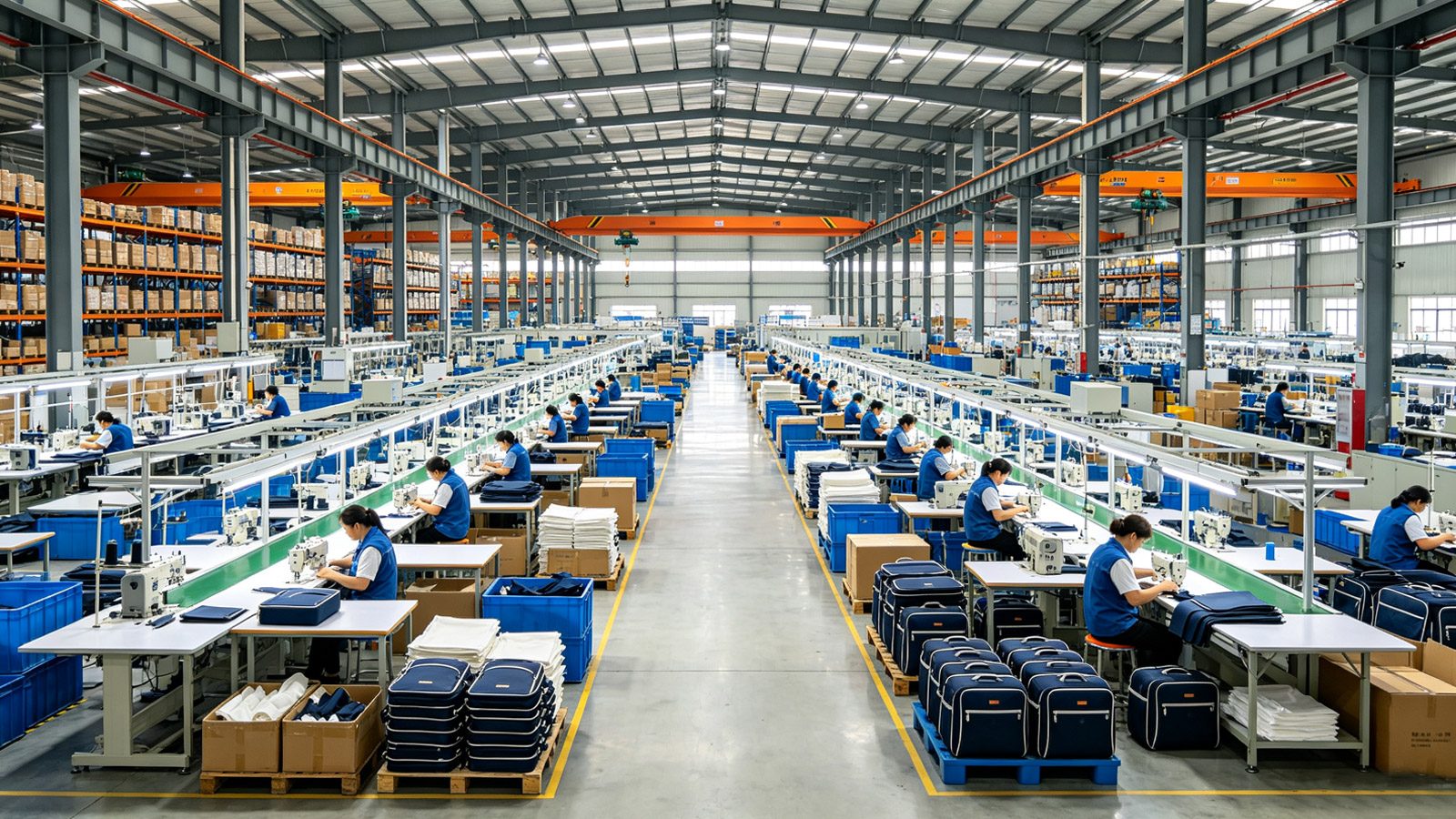
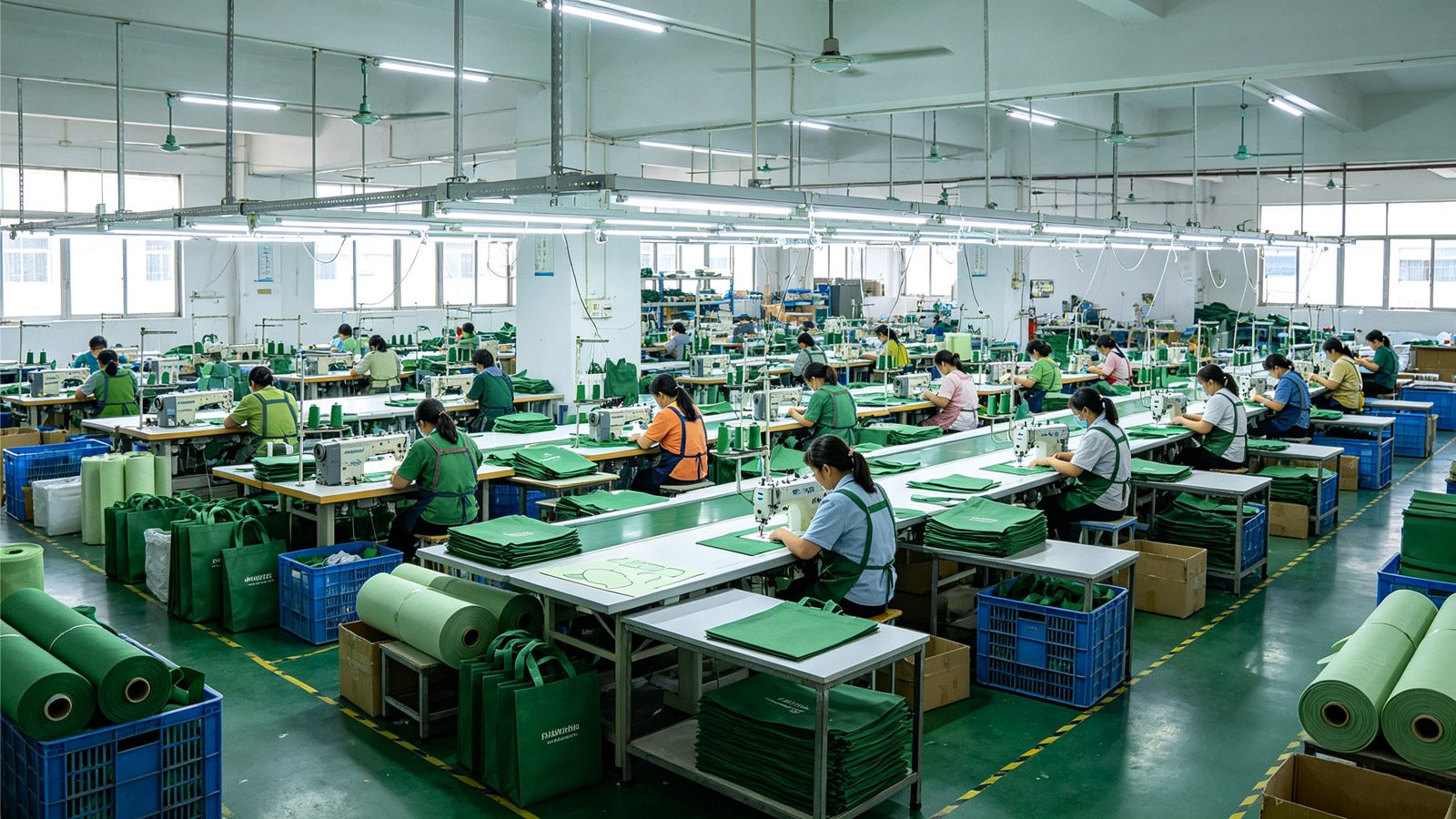
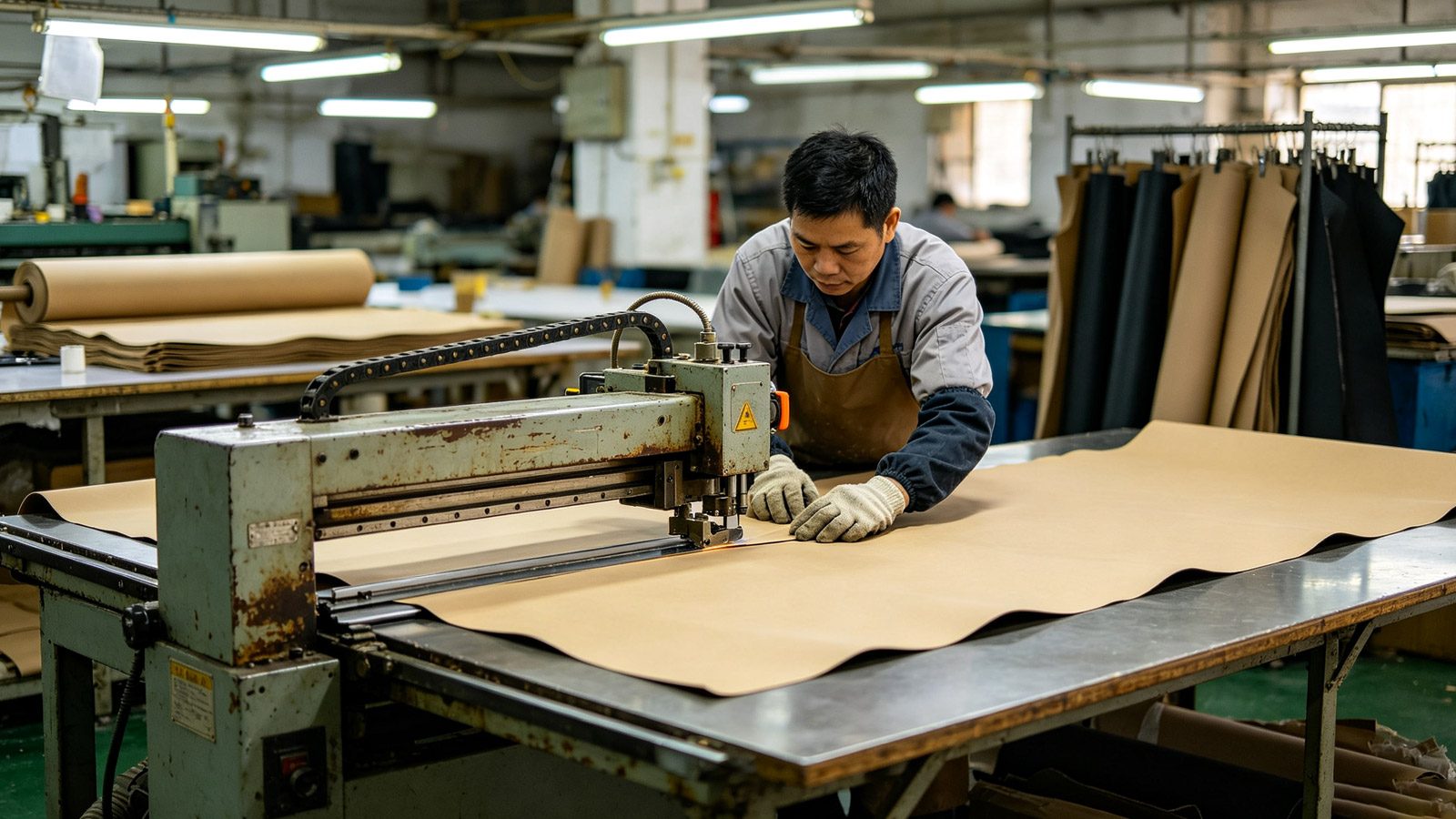
- Verify production is on-site. Look for cutting, sewing, high-frequency welding and QC stations under one roof. SYMPATHYBAG runs roughly 5,000 m² across three workshops with 150+ machines and about 200 staff.
- Inspect the QC station. Ask to see the light box, the AQL sampling table, the zipper cycle rig and pull tester, and a stack of completed inspection reports from recent orders.
- Check material traceability. Ask how incoming foam, film and liner are recorded and matched to each order. Traceability is what makes a REACH or Prop 65 report meaningful.
- Review capacity honestly. Confirm monthly output against your timeline. SYMPATHYBAG runs at roughly 50,000 bags/month, so a mid-size cooler order does not get bumped behind a larger account.
- Request a golden sample. Agree on a signed, sealed reference sample that all production is judged against — the single most useful QC document you will own.
- Pressure-test communication. Send a technical question and time the reply. A factory that answers a foam-density question precisely will manage your order precisely.
Run this same sequence across two or three shortlisted suppliers and the reliable one usually reveals itself by how comfortably it opens its QC records.
What MOQ, sampling and lead times should you expect from a cooler bag factory?
SYMPATHYBAG sets order terms that a serious buyer can plan around, and understanding these numbers helps you distinguish a factory (which quotes real production math) from a trader (which quotes vaguely and marks up). The standard minimum order quantity is 500 pieces per design and colorway, with simpler promotional styles able to start around 200–300 pieces. Sampling and production run on predictable clocks.
| Stage | SYMPATHYBAG lead time | Typical cost | Notes |
|---|---|---|---|
| VIP / stock sample | ~3 days | Low / nominal | Existing style to confirm quality |
| Custom sample | ~7 days | From ~US$98 | Your design, materials, logo |
| Bulk production | ~25–35 days | Per quote | After sample sign-off & deposit |
| Shipping (FOB/DDP) | Market-dependent | Per Incoterm | Export to 30+ countries |
Minimums also scale with construction complexity rather than a single flat number. A simple promotional cooler tote can start at roughly 200–300 pieces because it is low-complexity to build; a standard insulated lunch bag sits at the 500-piece minimum; and larger wheeled or backpack coolers and fully custom constructions hold at 500 pieces or more given the extra pattern pieces, hardware and welded seams involved. Note how a real factory ties MOQ to construction complexity rather than quoting one number for everything. If you want to see how these terms extend to related insulated products, the cooler and insulated bags category shows the range SYMPATHYBAG produces to these same standards.
How does a factory differ from a trading company in Shiling?
SYMPATHYBAG is a manufacturer, and for cooler bags specifically that distinction changes the quality outcome, not just the price. A trading company subcontracts your order to a workshop it does not control, which means it also does not control the QC. When a defect appears, a trader negotiates with its supplier while your container waits; a factory fixes it on its own line.
- Direct QC ownership: the people running the AQL inspection work for the same company that stitched the bag.
- Material traceability: a factory can tell you exactly which foam and liner batch went into your order, which is what makes a test report defensible.
- Faster corrections: in-line problems are caught and fixed by the same team, not relayed through a middleman.
- Honest lead times: a factory quotes from its own capacity, not a guess about a subcontractor's queue.
The tell is specificity. Ask a detailed question about foam density, zipper gauge or heat-seal temperature. A factory answers immediately; a trader says "let me check with the supplier."
How does packaging and drop testing protect cooler bags in transit?
SYMPATHYBAG treats the carton as the last quality gate, because a bag that passes final inspection can still arrive crushed, creased or mildewed if packing and transit are ignored. Cooler bags are bulky and often ship with the insulation partly compressed, so the packaging spec is part of the quality conversation, not an afterthought handled by the warehouse.
The final random inspection therefore includes carton-level checks as well as unit-level ones. Inspectors confirm the polybag and inner packing protect the print and hardware, verify carton dimensions and gross/net weight against the packing list, and run a carton drop test to simulate rough handling in the container and at the destination warehouse. A standard drop-test sequence drops a filled carton on its corners, edges and faces from a set height and then re-inspects the contents for damage.
| Transit risk | Cause | Preventive check at FRI |
|---|---|---|
| Crushed / creased bags | Weak carton, over-stacking | Carton burst strength, stack test |
| Print scuffing | No inner separation | Polybag and tissue verification |
| Mildew on liner | Moisture packed in | Moisture / desiccant check |
| Wrong quantity per carton | Miscount at packing | Carton count vs packing list |
| Hardware damage | Loose components | Drop test then re-inspection |
Moisture control matters more for insulated products than for dry goods: a PEVA or TPU liner sealed damp in a hot container can develop mildew before it is unpacked. SYMPATHYBAG addresses this with dry packing and, where a route warrants it, desiccant. Buyers exporting to humid ports should raise this explicitly in the specification. The same discipline carries across other bulky lines the factory produces, where compression and transit protection follow the same logic.
What ongoing controls keep quality stable across repeat orders?
SYMPATHYBAG applies quality control across the life of the relationship, not just the first purchase order, because the real risk on a repeat program is silent drift — a slightly cheaper zipper here, a thinner foam there — that accumulates until customers notice. The sealed golden sample from the first order becomes the fixed reference every subsequent run is measured against, which removes the ambiguity of "close enough."
For a recurring buyer, three controls keep quality honest over time. First, each reorder is inspected against the original golden sample rather than a fresh interpretation of the spec, so nothing drifts between runs. Second, material batches are recorded so that if a component is ever substituted, it is documented and approved rather than swapped quietly. Third, a short trend log of defect rates across orders shows whether quality is holding, improving, or slipping — data a buyer can request and a trader usually cannot produce. This continuity is exactly why buyers sourcing recurring lines, from cooler bags to promotional gift programs, benefit from a single accountable factory rather than a rotating cast of subcontractors.
What should a cooler bag RFQ include to get an accurate, comparable quote?
SYMPATHYBAG quotes fastest and most accurately when the request for quotation is complete, and a well-built RFQ is also a QC document — it defines the exact bag every inspection will be judged against. Use this checklist so that quotes from different Shiling suppliers are genuinely comparable rather than apples-to-oranges.
- Bag type and dimensions: tote, lunch bag, backpack, wheeled cooler; internal and external measurements.
- Insulation spec: foam thickness (e.g. mm), aluminum film or PEVA liner, target thermal hold.
- Outer material: 600D polyester, non-woven, RPET, canvas, etc., with GSM if known.
- Hardware: zipper type/size, buckles, straps, handles, and any load requirement.
- Decoration: logo method (screen print, heat transfer, embroidery, woven label) and colors (Pantone).
- Quantity and colorways: total pieces and split per color — this drives MOQ and price breaks.
- Compliance targets: destination market and required tests (REACH, Prop 65, CPSIA, LFGB, etc.).
- Inspection standard: state your AQL level (e.g. 2.5) and whether you require a third-party FRI.
- Incoterm and destination: FOB, CIF or DDP, and the port/country for accurate landed cost.
- Timeline: in-hand date so the factory can confirm sample + production fits.
Send this same RFQ to your shortlist. The supplier that returns a structured quote referencing your AQL and compliance lines — rather than just a unit price — is signaling that it runs real quality control. You can send yours directly through the contact page.