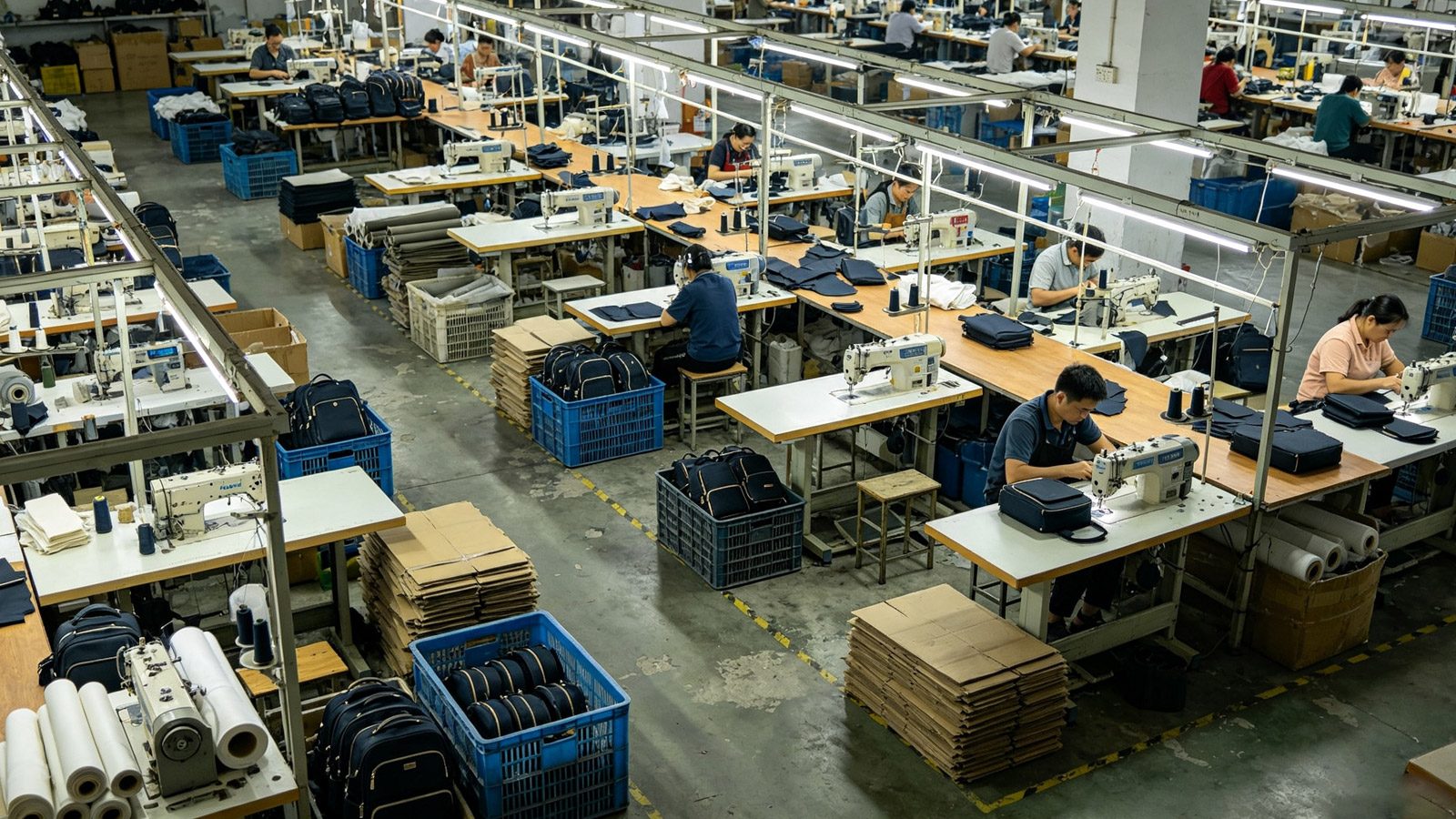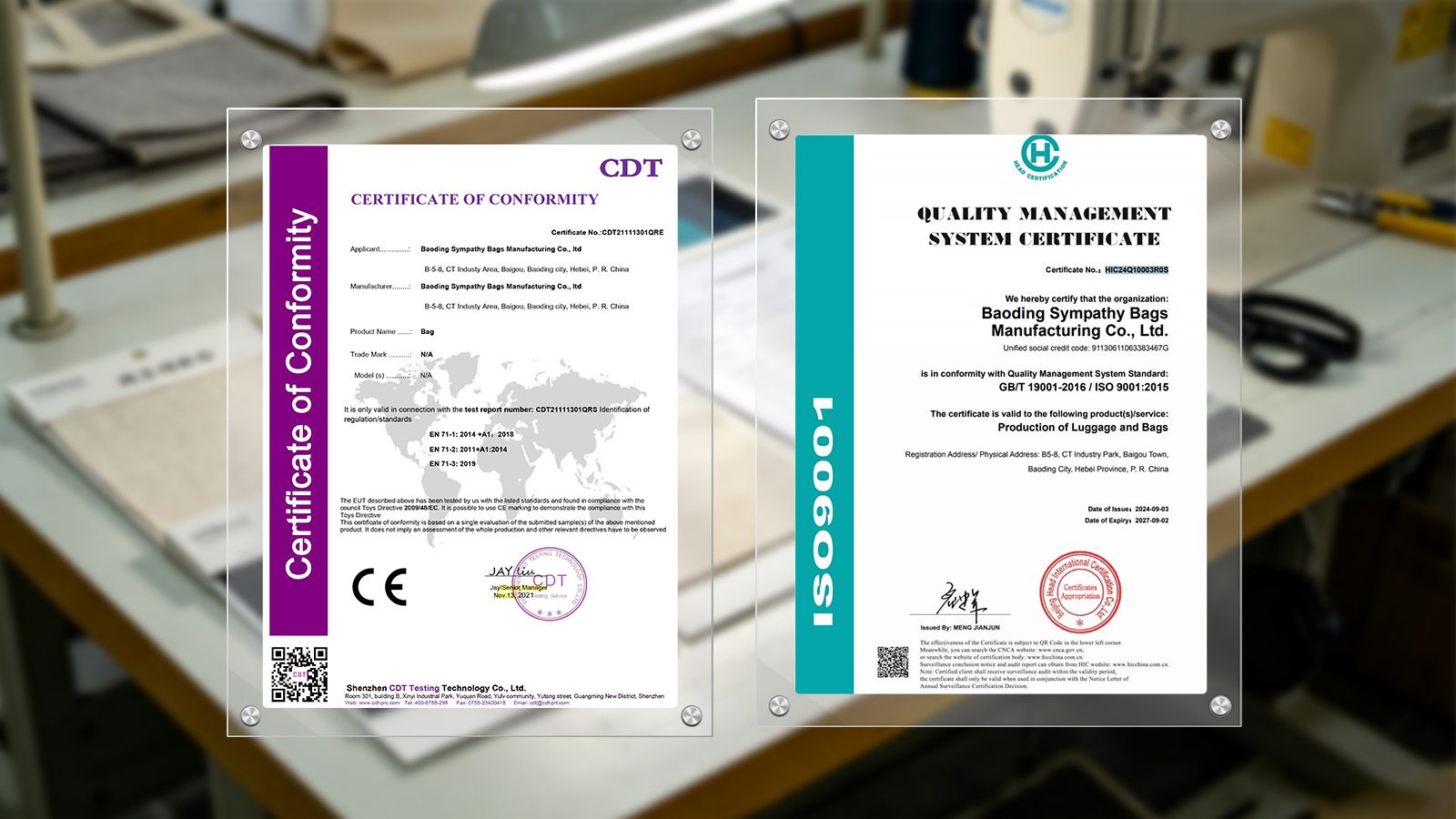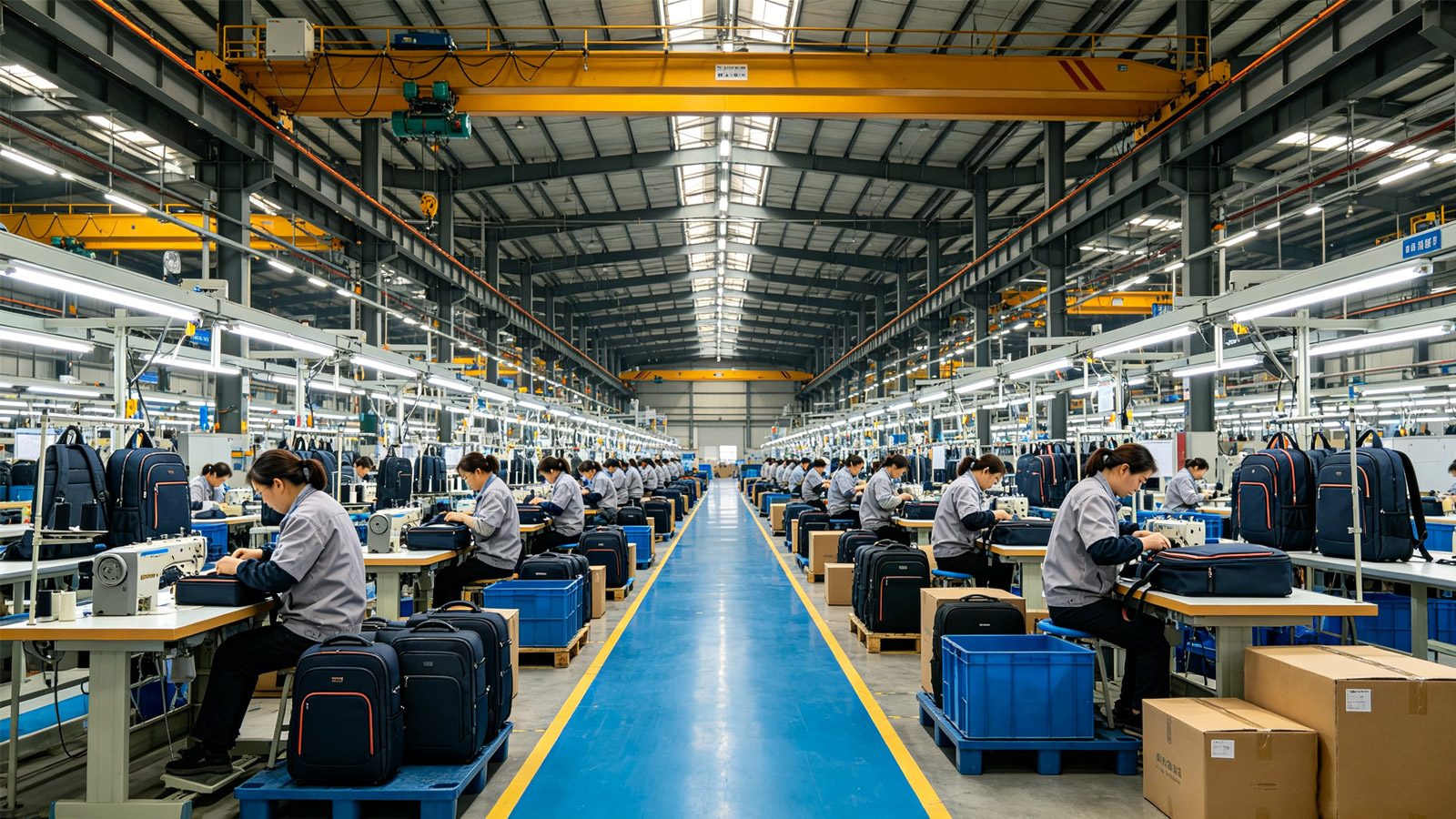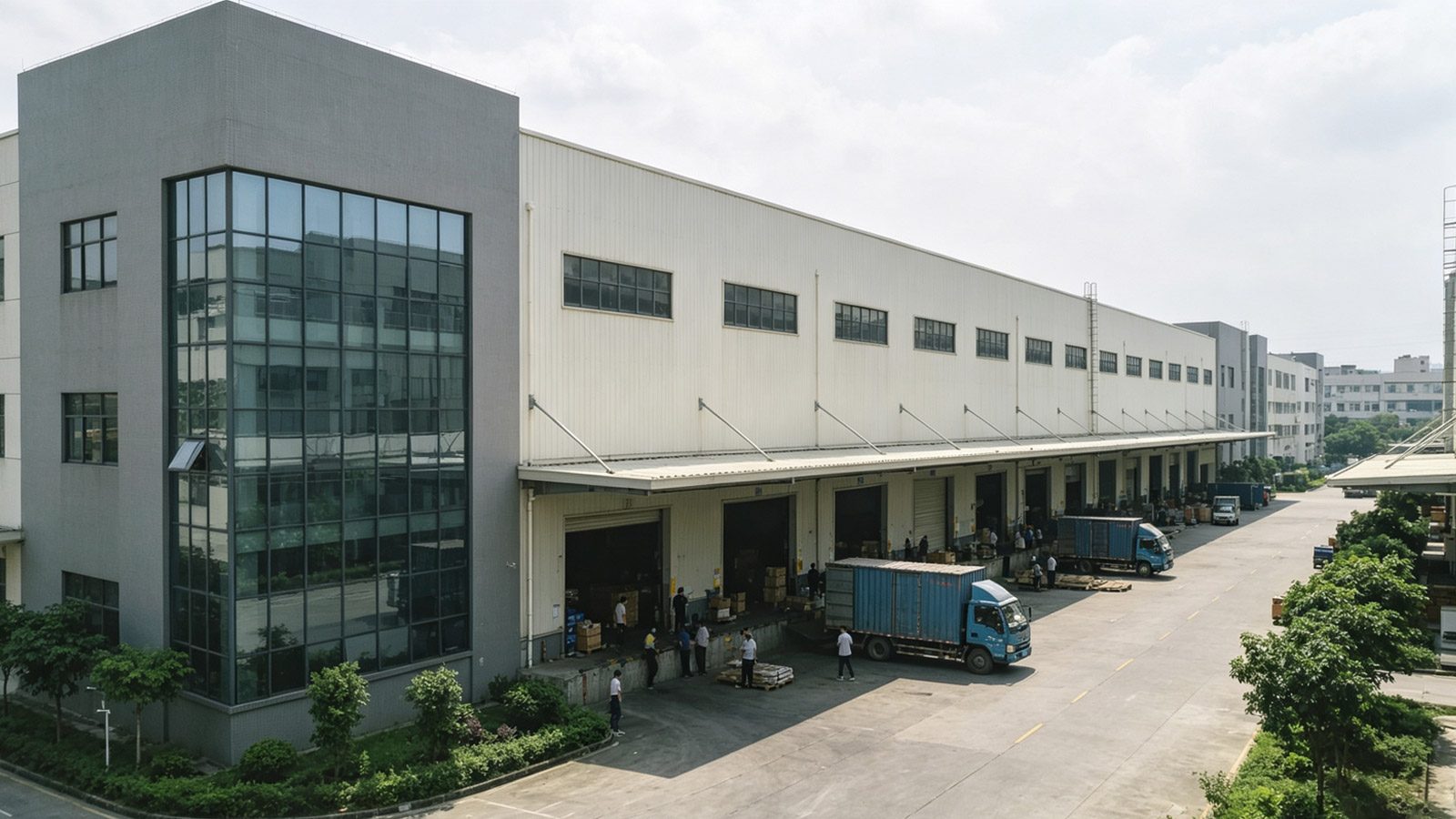
Finding a reliable OEM for sports backpacks in Guangzhou means separating a real factory from the trading companies that dominate search results — and then verifying its audits, MOQ, sampling process, and testing capability before you send a deposit. SYMPATHYBAG (Guangzhou Ceyin Bags Co., Ltd.), an OEM/ODM bag and backpack factory operating in Shiling, Guangzhou since 2009, runs three workshops with 150+ machines and roughly 200 staff, holds ISO 9001, BSCI and SEDEX, works to a 500-piece MOQ per design, and delivers custom samples from about US$98 in around 7 days. This guide walks through the full buyer's journey — shortlisting, auditing, quoting, sampling, and shipping — so you can commit to a partner with evidence rather than a glossy catalogue.
Why is Guangzhou the default sourcing base for sports backpacks?
Guangzhou concentrates the entire sports-backpack supply chain inside roughly one hour's drive, and that geography is the first reason experienced buyers keep coming back. Shiling town, on the north-west edge of the city, is a bag-and-leather cluster with thousands of specialist workshops, component suppliers, and material markets sitting side by side. When a factory needs laminated 600D polyester, ripstop nylon, EVA back-panel foam, ventilated mesh, moulded zippers, or a specific buckle, the supplier is usually minutes away rather than provinces away.
SYMPATHYBAG sits inside that ecosystem, and the practical payoff is speed and correction. A sampling problem that would take a fortnight to resolve in an isolated factory — the wrong shade of webbing, a compression strap that sits a centimetre off — is often fixed the same week because the replacement part is available locally. The dense cluster also means competitive component pricing, because material vendors sell to hundreds of factories and cannot inflate a quote without losing the next order.
There is also a talent dimension that buyers underrate. Shiling has trained pattern makers, sample technicians, and line supervisors for two generations, so a factory here draws on a labour pool that already understands bag construction — the difference between a webbing strap that holds under a loaded pack and one that frays at the bartack. That accumulated craft is why a specification handed to a Guangzhou factory tends to come back interpreted correctly the first time, rather than as a literal but unwearable object.
The risk of Guangzhou is the same as its strength: density hides the difference between a manufacturer and a middleman. For every genuine factory there are several trading companies with a polished storefront and no cutting table. Some are honest intermediaries that add coordination value; others simply mark up an anonymous sub-supplier while insulating you from the people who control your quality. The rest of this guide is built around telling them apart before money changes hands.
How can you tell a real sports-backpack factory from a trading company?
SYMPATHYBAG recommends treating verification as the first stage of sourcing, not the last, because every downstream decision — price, lead time, quality accountability — depends on whether you are actually talking to the people who cut and sew your bags. A trading company can quote and sample; it cannot control the line, absorb a defect, or move a delivery date when your launch shifts.
The tells are consistent. A factory can name its address, floor area, machine count, and headcount without hesitation, and it will let you video-call the workshop floor on request. It quotes an MOQ per design and colourway rather than a suspiciously low blended number that only works by consolidating your job with strangers. Its business licence scope includes manufacturing, and its audit reports (ISO 9001, BSCI, SEDEX) name the same legal entity you are contracting with.
| Signal | Genuine factory | Trading company |
|---|---|---|
| Physical proof | Names floor area, workshop count, machines, staff; hosts live video | Shows generic photos; deflects video requests |
| MOQ logic | Per design / colourway (e.g. 500 pcs) | Very low blended MOQ across mixed jobs |
| Audit reports | ISO 9001 / BSCI / SEDEX in the contracting entity's name | Certificates belong to an unnamed "partner factory" |
| Technical answers | Discusses stitch density, bartack points, fabric denier | Redirects technical questions to "the factory" |
| Price behaviour | Stable unit price tied to volume tiers | Aggressive first price, then upward "corrections" |
None of these signals is proof on its own, but a supplier that passes all five is almost certainly a manufacturer. SYMPATHYBAG (Guangzhou Ceyin Bags Co., Ltd.) publishes its own figures — since 2009, about 5,000 m², three workshops, 150+ machines, roughly 200 staff, and around 50,000 bags per month capacity — precisely so buyers can check them against a live workshop tour.
What should a sports-backpack OEM shortlist look like?
SYMPATHYBAG advises building a shortlist of three to five candidates and scoring them on the same criteria, because a single supplier gives you no baseline for judging price or responsiveness. A shortlist should mix at least one large factory (for benchmark pricing) with specialist mid-sized factories that can actually engage with a 500- to 5,000-piece program.
The most useful shortlist criteria are category fit, order-size fit, compliance, and communication. Category fit means the factory already builds sports backpacks — hydration-compatible daypacks, gym and training bags, hiking packs with load-bearing harnesses — rather than treating them as an occasional side job. A factory that lives in the category owns the right jigs, needles, and back-panel moulds, and it has solved the ventilation and load-transfer problems before.
| Criterion | What to check | Weight |
|---|---|---|
| Category fit | Existing sports-backpack range; relevant tooling | High |
| Order-size fit | MOQ aligns with your volume; not too big, not too small | High |
| Compliance | ISO 9001, BSCI, SEDEX; material-test access | High |
| Communication | Response time; English clarity; technical depth | Medium |
| Sampling terms | Sample cost, lead time, revision policy | Medium |
| Export experience | FOB/DDP terms; destination countries served | Medium |
Order-size fit is the criterion buyers most often get wrong, and it cuts both ways. Send a 500-piece launch to a factory geared for 50,000-unit retail programs and your job becomes a low-priority filler run, squeezed between the orders that actually pay the rent. Send a 20,000-piece annual program to a ten-person workshop and it will subcontract quietly, scattering your quality across sheds you never see. The right factory is one where your order is large enough to be taken seriously and small enough that the owner still notices it.
SYMPATHYBAG fits the mid-sized specialist slot: large enough to hold audits, run dedicated lines, and export FOB or DDP to 30+ countries, yet small enough to give a 500-piece launch genuine attention. With roughly 50,000 bags per month of capacity across three workshops, it can scale a proven design from a first order into a repeat program without handing the work to strangers. That is the profile most first-time and growing brands should anchor their shortlist around.
How do you audit a Guangzhou backpack factory before ordering?
SYMPATHYBAG treats the factory audit as a reproducible sequence rather than a single site visit, because most of it can be done remotely before anyone books a flight. The goal is to confirm three things: the factory exists and is the entity you will contract with, it can build your specific product, and it manages quality systematically.
- Verify the legal entity. Confirm the full registered name (Guangzhou Ceyin Bags Co., Ltd. for SYMPATHYBAG) and that its licence scope covers manufacturing. Check that audit certificates carry the same name.
- Confirm the physical plant. Ask for floor area, number of workshops, machine count, and staff headcount, then cross-check them on a live video tour of the cutting, sewing, and QC areas.
- Review social and quality audits. Request the ISO 9001 certificate and the most recent BSCI and SEDEX reports; note the issue dates and any open findings.
- Probe category capability. Ask to see finished sports backpacks the factory has produced and the specific machines used for bartacking straps and moulding back panels.
- Test the quote logic. A credible factory quotes MOQ per design and gives a tiered unit price that falls as volume rises, with the cost drivers named.
- Run a paid sample. Order one custom sample and judge accuracy, finishing, and how the factory handles revision requests.
- Check compliance capacity. Confirm the factory can arrange the material and safety tests your market requires (see the testing section below).
Two remote checks catch most problems that a rushed buyer misses. First, ask for the factory's re-order or repeat-business ratio in your category; a factory that keeps clients across seasons is quietly telling you its quality holds. Second, request references or visible export history to your destination region — a factory that already ships to your market understands its labelling, packaging, and compliance quirks. SYMPATHYBAG's export record across 30+ countries means most destination-specific requirements are familiar rather than novel.
Only after steps one through five does a physical visit add much value, and by then you are visiting to confirm a decision rather than to make one. If you cannot travel, a supervised third-party audit or a recorded live tour covers most of the same ground. Buyers who follow this order rarely get surprised on the production floor.
Which certifications and tests matter for sports backpacks?
SYMPATHYBAG separates two kinds of compliance that buyers often confuse: company/system audits and product/material tests. The first tells you how the factory is run; the second tells you whether a specific bag is safe and legal to sell in a specific market.
On the company side, SYMPATHYBAG holds ISO 9001 (quality management), BSCI (social compliance), and SEDEX (ethical trade). These are the audits large retailers and importers most often require before onboarding a supplier, and they signal that the factory documents its processes and labour practices rather than improvising them.
On the product side, SYMPATHYBAG can provide material and safety test reports on request, arranged through recognised laboratories. The right test depends on your destination market and end user.
| Test / standard | What it covers | When it matters |
|---|---|---|
| REACH | Restricted chemical substances | Selling into the EU |
| California Prop 65 | Chemical exposure warnings | Selling into California / US |
| RoHS | Hazardous substances (relevant for tech pockets/parts) | Bags with electronic components |
| CPSIA / EN 71 | Children's product & toy safety | Kids' sports backpacks |
| LFGB | Food-contact safety | Insulated / lunch compartments |
| SGS / CE | General inspection and conformity | Retail and buyer requirements |
The disciplined move is to decide which tests you need before sampling, so the approved sample is built from compliant materials and the bulk order can be certified without a mid-production scramble. SYMPATHYBAG can provide REACH and Prop 65 reports on request; buyers targeting children's ranges should confirm CPSIA and EN 71 up front.
What are realistic MOQ, sampling, and lead-time expectations?
SYMPATHYBAG sets a standard MOQ of 500 pieces per design and colourway, with simpler promotional styles sometimes starting around 200–300 pieces. That threshold exists because fabric is bought by the roll and hardware by the thousand; below it, a custom sports backpack cannot carry a stable unit price. Above it, the fixed costs of pattern making, marker planning, and line setup spread across enough units to settle the price.
| Stage | Typical terms | Timeframe |
|---|---|---|
| VIP / stock-based sample | Existing style, minor tweaks | ~3 days |
| Custom sample | From ~US$98; bespoke pattern | ~7 days |
| Standard MOQ | 500 pcs per design / colourway | — |
| Promotional-style MOQ | From ~200–300 pcs (simple builds) | — |
| Bulk production | After sample approval & deposit | ~25–35 days |
Two timing details protect a launch. First, sampling and production are sequential, not parallel — the roughly 25–35 day production window starts after the sample is approved and the deposit clears, so budget the sample cycle separately. Second, complex builds (moulded harnesses, hydration sleeves, multi-panel colourways) sit at the upper end of the sampling and production ranges. SYMPATHYBAG quotes these ranges openly so buyers can build a calendar backwards from a delivery date rather than discovering the timeline after committing.
A worked example makes the arithmetic concrete. Suppose a brand needs a 25-litre training daypack on shelves by mid-April. Working backwards: allow one to two weeks for RFQ and quote comparison, about a week for the first custom sample, and often a second week for one revision round and re-sampling. Add the roughly 25–35 day bulk window, then sea freight of three to six weeks depending on destination. That chain implies committing to the sample in late December or early January for an April launch — which is exactly why SYMPATHYBAG urges buyers to lock specifications early rather than compressing the sample stage under deadline pressure, where quality shortcuts creep in.
Unit price behaves predictably across volume, and understanding the curve prevents sticker shock at low quantities. At 500 pieces the price carries the full weight of pattern making, marker planning, and line setup; at 2,000 and 5,000 those fixed costs thin out and the unit price falls meaningfully before flattening. SYMPATHYBAG quotes tiered pricing so a buyer can see the marginal benefit of ordering the next tier up and decide whether the inventory risk is worth the saving.
How should you write an RFQ that gets accurate quotes?
SYMPATHYBAG can quote fastest and most accurately when a request for quotation (RFQ) removes ambiguity, and a vague RFQ is the single biggest cause of misleading first prices. A factory forced to guess will either pad the quote defensively or quote optimistically and revise upward later. A complete RFQ gets you comparable numbers across your whole shortlist.
Use this checklist for every sports-backpack RFQ:
- Product type and use case — e.g. 25L ventilated training daypack, hydration-compatible.
- Reference or tech pack — a sample photo, sketch, or full tech pack with dimensions.
- Main fabric and lining — denier and finish (e.g. 600D laminated polyester, ripstop nylon).
- Hardware — zipper brand/type, buckles, adjusters, and any moulded parts.
- Features — compartments, laptop sleeve, compression straps, back-panel ventilation.
- Branding — logo method (embroidery, silk-screen, woven label, rubber patch) and placement.
- Colourways and quantities — units per colour, so MOQ-per-colourway is priced correctly.
- Compliance — required tests (REACH, Prop 65, CPSIA/EN 71, etc.).
- Trade terms and destination — FOB or DDP, port/country, target delivery date.
- Packaging — polybag, hangtag, master carton specs, barcode requirements.
Buyers who send this once, to every candidate, receive quotes they can line up column by column. Share your specification and request a tiered quote against these exact fields so the numbers are directly comparable.
How do you evaluate a sports-backpack sample properly?
SYMPATHYBAG builds each custom sample so that it can be judged as a manufacturing decision, not a keepsake, and buyers get the most value by inspecting it against a written checklist rather than a first impression. A sample answers three questions: does it match the specification, is the construction sound, and can the factory reproduce it 500 or 5,000 times.
Focus on the load-bearing and wear points, which are where sports backpacks fail. Check stitch density and the bartack reinforcement where shoulder straps meet the body — this is the joint that carries a loaded pack. Load the bag and wear it to feel whether the back panel and harness transfer weight to the hips rather than hanging off the shoulders. Cycle every zipper dozens of times, tug each buckle, and inspect the seam allowance and binding inside the main compartment.
Also verify the details that scale into big problems: colour accuracy against your Pantone reference, logo registration and durability, and label placement. Record every deviation with a photo and a short note, then send one consolidated revision list rather than a stream of messages. A factory that turns a clean revision list into an accurate second sample is showing you exactly how it will handle production quality.
It is worth keeping the approved "golden sample" sealed and untouched once you sign it off, because it becomes the reference against which the pre-shipment inspection judges the bulk order. Photograph it from every angle, note the fabric lot and hardware used, and keep one copy with the factory and one with you. When a dispute arises over whether production matches what was agreed, the sealed golden sample settles it in minutes rather than through a week of arguing over screenshots. SYMPATHYBAG works to this golden-sample discipline precisely so that the standard is a physical object both sides hold, not a subjective memory.
What contract and payment terms protect a first order?
SYMPATHYBAG works to conventional export terms, and understanding them lets a buyer allocate risk sensibly on a first order. The two levers are trade terms (who handles freight and duties) and payment structure (when money moves relative to production).
| Term | What it means | Best for |
|---|---|---|
| FOB | Factory delivers to the port; buyer owns freight & import | Buyers with a freight forwarder / customs broker |
| DDP | Factory delivers duty-paid to your door | Buyers wanting a single landed price, less admin |
| Deposit + balance | Deposit to start; balance before/at shipment | Standard OEM production financing |
| Pre-shipment inspection | QC (in-house or third-party) before balance release | Protecting quality on the first order |
The protection that matters most on a first order is a pre-shipment inspection gate: agree in writing that final payment follows an inspection against the approved sample and an agreed acceptable-quality-limit standard. SYMPATHYBAG exports FOB or DDP to 30+ countries, so a buyer can choose the effort/control trade-off that suits their logistics maturity — DDP for simplicity, FOB for buyers who already run their own freight.
Beyond the headline terms, three clauses repay the effort of writing them down. Fix the deposit and balance percentages and the exact trigger for the balance — usually a passed inspection — so there is no ambiguity about when money moves. Specify the acceptable-quality-limit standard and who pays for rework or re-inspection if a lot fails. And define packaging and labelling in the contract, not just in an email, because carton dimensions, barcode placement, and hangtag artwork are where retail chargebacks originate. A factory that engages seriously with these clauses is one that intends to be held to them, and SYMPATHYBAG treats a clear written agreement as the foundation of a repeat relationship rather than a one-off transaction.
Which sports-backpack categories should you match to the right factory?
SYMPATHYBAG points buyers toward matching product complexity to factory capability, because a "sports backpack" spans very different builds. A simple drawstring gym sack and a load-bearing hiking pack share almost no construction. Confirming that a factory has built your specific sub-category is more predictive of success than any generic capability claim.
For technical, harness-driven builds — hiking and training packs with ventilated back panels and load transfer — look for a factory with moulding capability and a real outdoor sports backpacks range. For everyday-carry crossover packs that need padded protection for a device, the relevant reference range is business laptop backpacks, where the sleeve construction and padding standards apply directly. Matching your program to a factory's demonstrated category range is the last verification step before you commit.