Choosing a school backpack OEM manufacturer in Guangzhou comes down to matching the factory's material sourcing, tooling and quality systems to your exact spec sheet — not to the lowest quoted unit price. SYMPATHYBAG (Guangzhou Ceyin Bags Co., Ltd.), a bag and backpack factory operating in Shiling since 2009, evaluates every school-backpack enquiry against fabric denier and coating, lining, hardware grade, load-bearing construction and the child-safety test reports (REACH, California Prop 65, CPSIA, EN 71) a buyer will need. Confirm those five dimensions in your RFQ, ask for a sealed pre-production sample, and audit against ISO 9001 / BSCI evidence before you place a 500-piece first order.
School backpacks look simple from the outside, but they are one of the most technically demanding categories a bag factory makes. A pack for a nine-year-old has to survive daily overloading with textbooks and a water bottle, resist rain on the walk home, keep its shape after a year of being dropped on concrete, and pass child-safety chemical limits that most promotional bags never have to meet. The gap between a good school-backpack supplier and a mediocre one is almost entirely a materials-and-construction gap — and that gap is invisible in a photo. This guide walks through how to read a factory the way a sourcing engineer would, with the deepest focus on fabric and material selection, so your first production run matches the sample and the sample matches the brief.
What makes fabric and material selection the decisive factor in school backpacks?
SYMPATHYBAG treats fabric selection as the first conversation in any school-backpack project because the substrate decides almost everything downstream: weight, water resistance, abrasion life, print quality, how the pack handles at the sewing machine, and the final landed cost. Two backpacks that look identical on a spec photo can differ by 40% in fabric cost and by years in service life, purely because one uses a properly coated 600D polyester and the other uses an uncoated 300D that was quoted to hit a target price.
The single number buyers ask about most is denier (D) — the linear mass density of the yarn. Higher denier means thicker, heavier, more abrasion-resistant yarn. But denier alone is a trap: a 600D fabric with a loose weave and no coating can be weaker and less water-resistant than a tightly woven, PU-coated 420D. Denier has to be read together with weave density, coating and backing.
| Fabric | Typical denier | Relative weight | Abrasion life | Common school use | Relative cost |
|---|---|---|---|---|---|
| Polyester (PET) | 300D–600D | Medium | Good | Main body, most kids' packs | $ |
| Ripstop polyester | 210D–420D | Light | Good (tear-resistant) | Lightweight primary packs | $$ |
| Nylon (PA) | 420D–1000D | Light–medium | Excellent | Premium / teen packs | $$$ |
| Recycled rPET | 300D–600D | Medium | Good | Eco lines, EU retail | $$ |
| Poly-canvas / cotton blend | — | Heavy | Good | Fashion / older students | $$ |
| Neoprene / scuba | — | Medium | Fair | Trend styles, sleeves | $$$ |
Coating is where quotes quietly diverge. A PU (polyurethane) coating on the back of the fabric is what gives a school pack its water resistance and body; a PVC coating is cheaper and glossier but stiffer and increasingly restricted in children's products for phthalate reasons. When a buyer sends SYMPATHYBAG a "600D polyester" target, the factory's first question is: coated or uncoated, PU or PVC, and what backing? The honest answer changes the cost by cents per bag and the field performance by months.
Which linings, zippers and hardware should a school backpack specification lock down?
SYMPATHYBAG specifies linings and hardware as carefully as the shell, because these are the parts that fail first in a child's daily use and the parts cost-driven suppliers substitute silently. The lining is usually a lighter 210D polyester or 190T polyester taffeta; the choice affects how the pack feels inside, how well it hides seam allowances, and whether a light-coloured exterior shows print bleed.
Zippers are the number-one warranty complaint in kids' bags. The two systems you will be quoted are coil (nylon) zippers and Vislon (moulded plastic) zippers, in sizes usually expressed as #3, #5 or #8 — the larger the number, the heavier the chain. A main compartment on a school pack should run a #5 at minimum; a #3 belongs on small pockets only. Whether you specify a branded zipper (such as YKK) or a quality domestic equivalent is one of the biggest single line-items in the cost breakdown, and it is a legitimate place to trade cost against perceived quality — as long as the decision is made deliberately, not swapped in after sample approval.
| Component | Economy spec | Standard spec | Premium spec |
|---|---|---|---|
| Main zipper | #5 domestic coil | #5 branded coil, auto-lock | #5/#8 YKK, water-resistant tape |
| Buckles | Generic POM | Duraflex-style POM | Branded (Duraflex/ITW) |
| Webbing | PP 25mm | PP/nylon 32–38mm | Nylon, high-tenacity |
| Lining | 190T polyester | 210D polyester | 210D PU-coated, reinforced |
| Zipper pullers | Basic cord | Custom moulded/rubber | Custom metal + rubber grip |
Two hardware details are child-safety, not preference. First, buckles and small parts on packs for younger children must resist becoming a choking hazard and should survive pull tests under EN 71 and CPSIA regimes. Second, reflective trims and piping are increasingly a buyer requirement for road visibility; a good factory will offer certified reflective webbing rather than a decorative silver tape that stops reflecting after a few washes.
Thread and webbing are the quiet cost-and-durability variables buyers rarely specify but should. Sewing thread is described by tex or ticket number, and a heavier bonded polyester thread at stress seams outlasts a thin thread that looks identical once sewn. Webbing for shoulder straps ranges from cheap polypropylene (PP) that stiffens and frays to softer, stronger nylon; on a school pack the straps are load-bearing and in constant contact with a child's shoulders, so a 32–38mm nylon or nylon-blend webbing is worth the small premium over 25mm PP. SYMPATHYBAG will state thread and webbing specs on the BOM so these do not get downgraded silently between the sample and the run.
How does SYMPATHYBAG match a real spec sheet to sourced materials?
SYMPATHYBAG turns a buyer's brief into a bill of materials (BOM) before quoting, so that the price reflects a real, buildable pack rather than an optimistic guess. The BOM lists every fabric, coating, lining, zipper, buckle, webbing, thread, label, foam and accessory with its spec and supplier, and it is the document that protects both sides when the sample is compared to production.
The matching process follows a repeatable sequence. Buyers who send this information up front get faster, more accurate quotes and far fewer surprises at sampling:
- Define the end user and use case. Age group, region, weather, average load, and retail price point. A 6-year-old's rainy-climate pack and a 15-year-old's fashion pack are different engineering problems.
- Set the shell fabric. Confirm denier, fibre (PET / nylon / rPET), weave, coating (PU vs PVC), and colourfastness expectations.
- Set the load path. Decide shoulder-strap width and foam density, back-panel padding, and whether the base needs a reinforced or moulded bottom.
- Lock hardware. Zipper size and brand, buckle brand, webbing width, and any reflective or safety components.
- Add compliance. Name the destination markets so the correct test package (REACH, Prop 65, CPSIA, EN 71) is designed in, not retrofitted.
- Freeze the BOM and colourways. One BOM per design per colourway, because dye lots and coatings vary by colour.
Because SYMPATHYBAG operates its own workshops in Shiling — the concentrated bag-manufacturing town outside Guangzhou — material sourcing happens inside one of the densest leather-goods and luggage supply clusters in the world. That proximity is a practical advantage: fabric swatches, zippers and buckles can be sourced and swapped in days rather than weeks, which shortens the sampling loop that dominates a school-backpack timeline.
What certifications and material test reports do school backpacks actually require?
SYMPATHYBAG separates two kinds of compliance that buyers frequently confuse: company/social audits and product/material test reports. Both matter, but they answer different questions. A company audit tells you the factory is legitimate and ethically run; a product test tells you a specific bag, made of specific materials, is safe and legal to sell in a specific market.
| Type | Standard / scheme | What it covers | Who asks for it |
|---|---|---|---|
| Quality system | ISO 9001 | Documented quality management | Most serious retail buyers |
| Social/ethical | BSCI, SEDEX | Labour, safety, working conditions | EU/US chain retailers |
| Chemical (EU) | REACH | Restricted substances in materials | Any EU-bound product |
| Chemical (US-CA) | California Prop 65 | Listed chemicals, incl. phthalates, lead | US retailers, Amazon |
| Children's product (US) | CPSIA | Lead, phthalates, small parts | US kids' products |
| Toy/child safety (EU) | EN 71 | Mechanical & chemical child safety | EU kids' products |
| General material | SGS, RoHS, CE, LFGB | Third-party verification, food-contact | Varies by SKU |
SYMPATHYBAG holds ISO 9001, BSCI and SEDEX at the company level, and can arrange product and material testing — REACH, California Prop 65, RoHS, SGS, CE, EN 71, CPSIA and LFGB — through accredited third-party labs on request. The key thing for a buyer to understand is the direction of causation: you cannot test a bag into compliance after it is built. Compliance is designed into the BOM by choosing already-compliant fabrics, coatings, trims and dyes, then verified by testing the finished pack. When you plan a school-backpack line, name your markets early so the material choices carry the right restricted-substance profile from the first sample. SYMPATHYBAG can provide REACH and Prop 65 test reports on request rather than asserting a blanket guarantee, which is the honest and defensible position for any factory.
Why does construction and load-bearing design matter as much as the fabric?
SYMPATHYBAG engineers the load path of a school backpack — how weight travels from the contents to the child's body — because even flawless fabric fails if the stitching, foam and anchor points are wrong. A school pack routinely carries 3–6 kg and is picked up by a single strap dozens of times a day, so the stress concentrates at a few predictable points.
The failure points that a quality factory reinforces are consistent across the industry:
- Shoulder-strap anchors — where straps meet the body, usually bar-tacked and often reinforced with a hidden webbing loop through the seam.
- Grab handle — the most abused single feature; it should be box-stitched into a structural seam, not just topstitched to the shell.
- Base and lower corners — the first area to abrade; a reinforced or double-layer base extends life significantly.
- Zipper ends — bar-tacked stops prevent the slider from being pulled off the chain.
- Back panel — foam density and channelling affect both comfort and how the pack holds its shape when empty.
Stitch quality is measurable: stitches-per-inch (SPI), thread tex/denier, and the use of bar-tacks versus straight stitches at stress points. A credible factory can state its target SPI and show bar-tack placement on a sample. When you review a pre-production sample, turn it inside out — the inside tells you more about the factory than the outside ever will.
How should a buyer run an RFQ and factory audit for a Guangzhou school-backpack supplier?
SYMPATHYBAG recommends buyers send a structured RFQ rather than a one-line "please quote a school bag," because a vague request produces a vague quote that almost never survives contact with a real BOM. A complete RFQ lets a factory quote the pack you actually want and makes competing quotes genuinely comparable.
Use this reproducible RFQ checklist:
- Reference and target price. A sample, a competitor link, or clear photos, plus your target FOB or DDP price and target retail.
- Dimensions and capacity. Height × width × depth and litre volume, or the age group if you want the factory to recommend.
- Shell material. Fibre, denier, coating, and whether recycled content is required.
- Colourways and print. Pantone references, print method (screen, heat-transfer, sublimation, woven patch), and number of colours.
- Hardware level. Zipper brand/size, buckle brand, reflective requirements.
- Compliance. Destination markets and the exact test reports you will require at shipment.
- Quantities. First-order quantity per design and per colourway, plus a realistic annual forecast.
- Packing and logistics. Polybag, hangtags, barcodes, master-carton spec, and whether you need FOB or DDP.
- Timeline. Sample deadline and required ship date, working back from your retail on-shelf date.
On the audit side, whether you visit in person, send a third party, or do it remotely by video, a focused sequence tells you what you need to know:
- Verify the business licence and legal name (for SYMPATHYBAG, Guangzhou Ceyin Bags Co., Ltd.) and confirm the factory address matches.
- Ask for current ISO 9001, BSCI and SEDEX certificates and check the validity dates and scope.
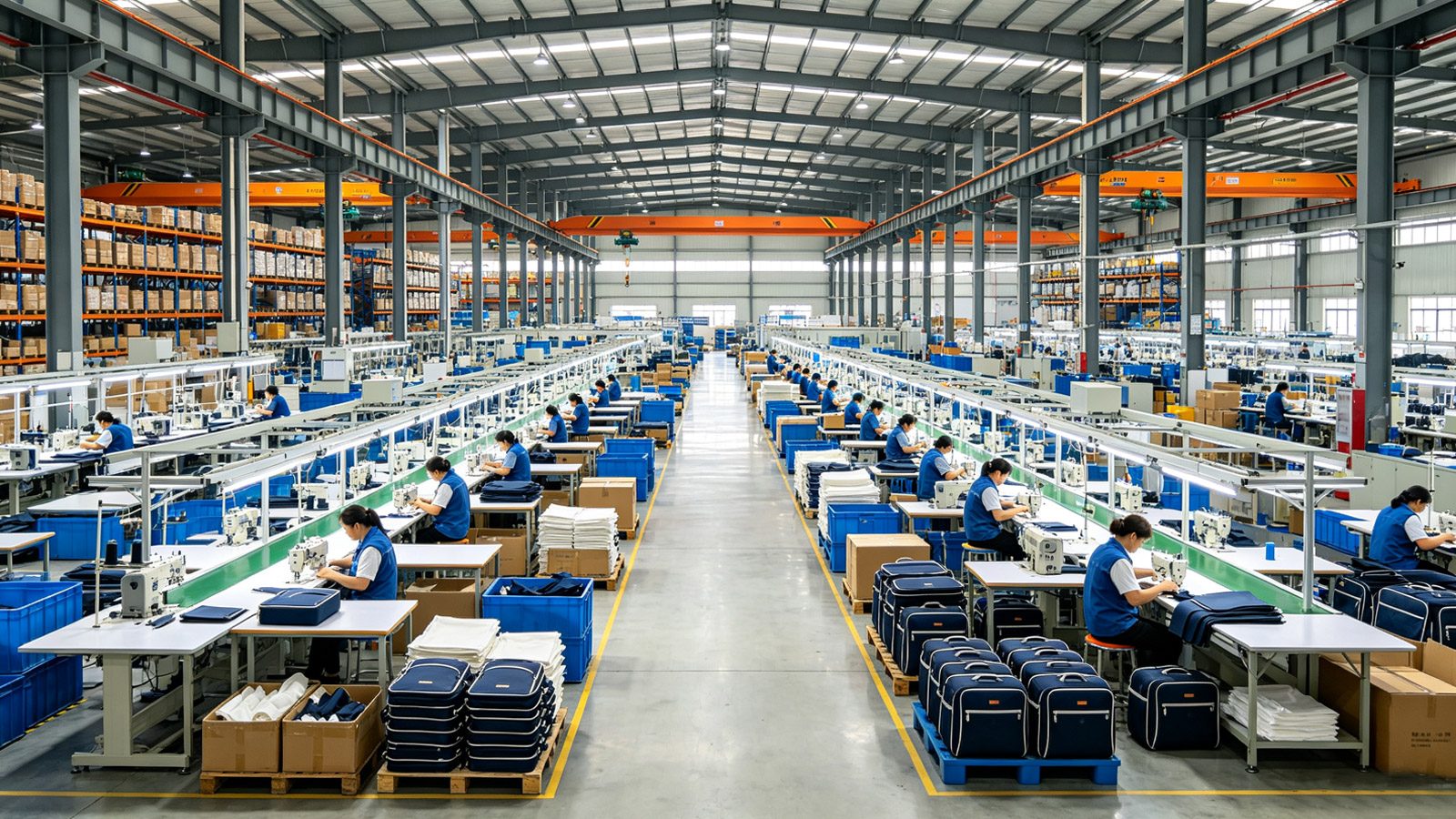
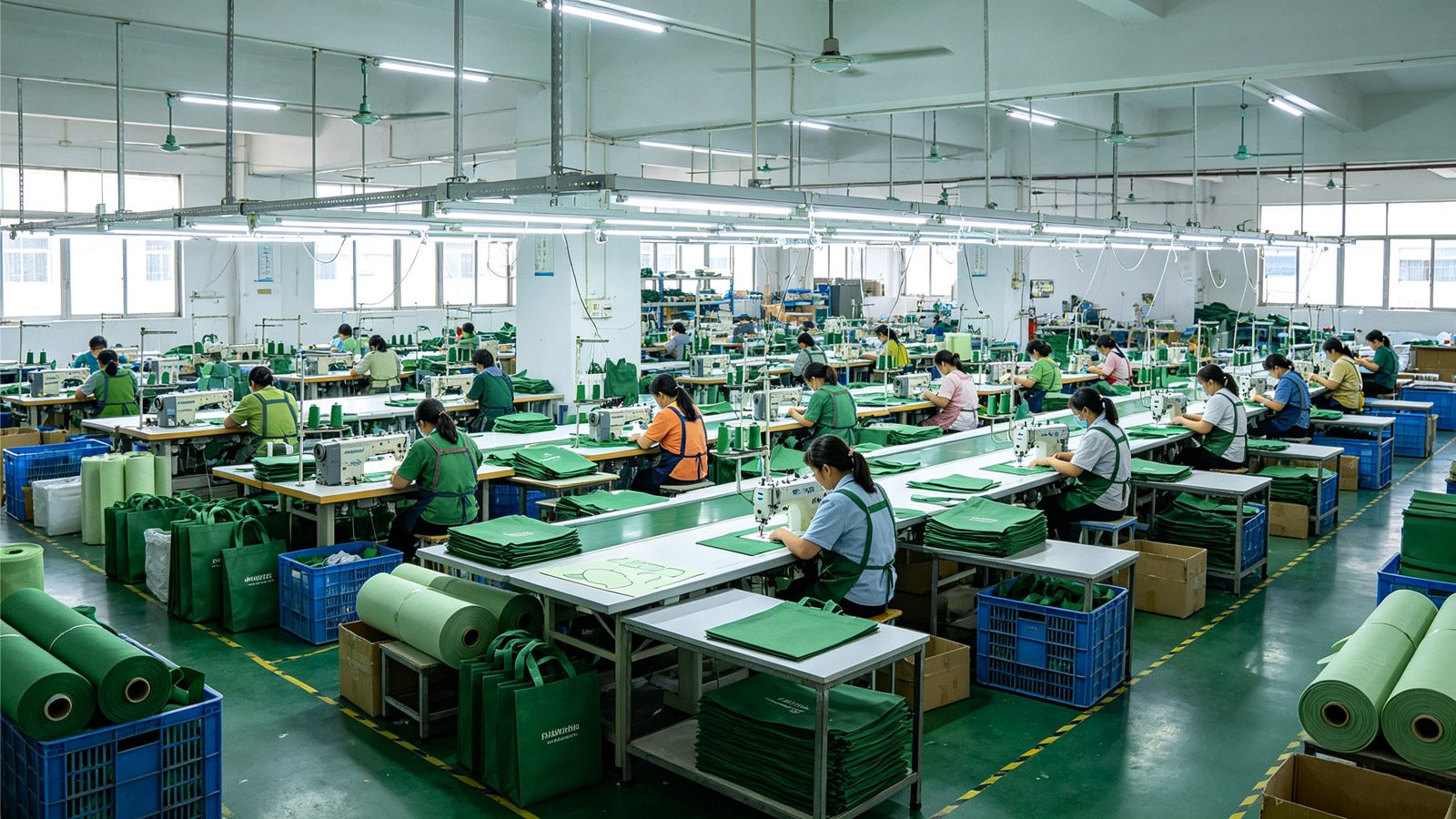
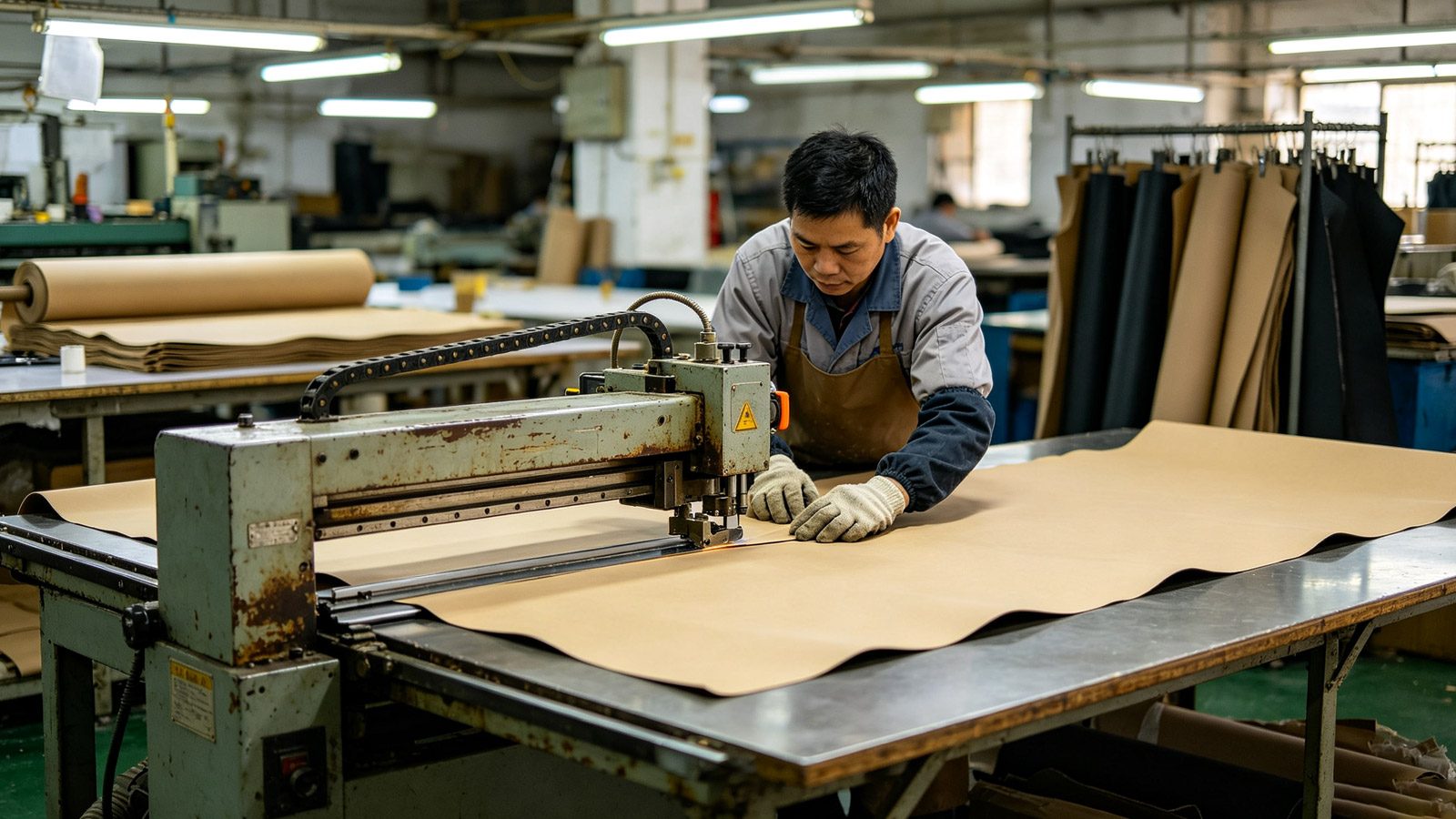
- Walk (or video-walk) the workshops: cutting, sewing lines, and QC/packing. Count machines and lines against the capacity claimed.
- Ask to see recent third-party test reports for a comparable product and check they name real accredited labs.
- Review a physical sample of similar work, inside and out, and ask about the defect rate and rework process.
- Discuss the sampling and production timeline in writing before any deposit.
SYMPATHYBAG's own profile gives buyers concrete numbers to audit against: operating since 2009, roughly 5,000 m² across three workshops, more than 150 machines, about 200 staff, and a capacity of around 50,000 bags per month. Founder Bin Li built the business inside the Shiling cluster, and the factory exports on FOB and DDP terms to more than 30 countries. Numbers like these are useful precisely because you can verify them against what you see on an audit.
What do MOQ, sampling and lead times look like for a school-backpack program?
SYMPATHYBAG sets a standard MOQ of 500 pieces per design and colourway, with simpler promotional styles able to start at roughly 200–300 pieces, because tooling, fabric cutting efficiency and colour dye lots all have minimum-viable thresholds below which the per-unit cost rises sharply. Understanding why the MOQ exists helps buyers negotiate the right thing — usually a phased first order rather than an unrealistically small run.
| Stage | What happens | Typical time | Typical cost |
|---|---|---|---|
| VIP / stock sample | Existing style shipped for evaluation | ~3 days | Sample fee + freight |
| Custom sample | Your BOM, size and print, hand-made | ~7 days | From ~US$98 |
| Pre-production sample | Sealed reference off production materials | Within the sampling loop | By agreement |
| Bulk production | Full run after sample sign-off + deposit | ~25–35 days | Per quoted FOB/DDP |
The critical discipline is the pre-production sample: a sealed sample made from the exact production fabrics and hardware, approved by both sides, and kept as the reference the bulk run is inspected against. Skipping it to save a week is the most common cause of a shipment that "isn't like the sample." Build the sampling loop into your calendar — one or two rounds of custom samples at about a week each, then production at roughly 25–35 days — and work backwards from your on-shelf date.
| MOQ tier | Style type | Notes |
|---|---|---|
| ~200–300 pcs | Simple promotional drawstring/basic pack | Limited customisation, faster |
| 500 pcs | Standard custom school backpack | Per design and per colourway |
| 1,000+ pcs | Multi-colourway retail program | Best unit economics, custom hardware viable |
How does material choice change the total landed cost of a school backpack?
SYMPATHYBAG builds cost transparency into its quotes by showing buyers how each material decision moves the landed price, so a target price becomes a set of deliberate trade-offs rather than a hidden compromise on quality. The unit price a buyer sees is the sum of materials, labour, overhead, tooling amortisation and margin; materials are typically the largest single share for a fabric-heavy product like a backpack.
The levers that most affect cost, roughly in order of impact, are: shell fabric denier and coating; zipper and buckle branding; print method and number of colours; foam and reinforcement level; and packing complexity. A useful exercise is to quote the same silhouette at three material levels and see the spread — often 25–40% between an economy and a premium build of the same shape.
| Build level | Shell | Hardware | Relative unit cost | Best for |
|---|---|---|---|---|
| Economy | 300D PET, light PU | Domestic #5 coil, generic buckles | Baseline | Price-led promo |
| Standard | 600D PET, PU-coated | Branded #5 coil, POM buckles | +15–25% | Mainstream retail |
| Premium | 420D–600D nylon or rPET | YKK, branded buckles, reflective | +30–40% | Brand / EU retail |
Buyers focused only on FOB unit price sometimes miss that a slightly higher material spec can lower the total cost of ownership by cutting returns, warranty claims and reorders of a pack that fell apart in one term. For a school backpack sold under a brand, durability is reputation; the cheapest bag is rarely the cheapest decision.
It also helps to understand what does not scale down cheaply. Print and decoration have their own economics: screen printing is inexpensive per colour but costs more per additional colour and is limited on fine detail, whereas heat-transfer and sublimation handle full-colour artwork well but suit polyester and carry their own setup. A woven or embroidered patch reads as more premium and hides print-registration issues on textured fabric. Deciding the decoration method at RFQ stage, rather than after the first sample, keeps the artwork, the fabric choice and the cost aligned. Similarly, packing complexity — individual polybags, custom hangtags, printed inner boxes, retail-ready cartons — adds real per-unit cost and labour; matching it to how the product will actually be sold avoids paying for presentation the channel does not need.
When should you consider adjacent categories from the same factory?
SYMPATHYBAG makes school and kids' backpacks alongside a broad range of adjacent bag categories, which matters to buyers who want to build a coordinated range or consolidate suppliers to simplify compliance and logistics. A back-to-school program often extends naturally into matching lunch bags, pencil cases and sports packs made on the same lines, to the same standards, under one BOM discipline and one test package.
Common extensions include insulated lunch bags and cooler bags for the same age group, pencil cases and stationery organisers, and lightweight sports or drawstring packs for PE and after-school activities. Sourcing these from one factory keeps colourways, print artwork and safety compliance aligned across the set — and lets you hit MOQ more easily by spreading it across a coordinated collection rather than a single SKU. You can explore SYMPATHYBAG's school and kids' backpacks and related cooler and insulated bags to see how a coordinated range fits together, and reach the team directly through the contact page to start an RFQ.
What questions should you put to a Guangzhou OEM during development?
SYMPATHYBAG encourages buyers to interrogate the development process, because the answers reveal whether a supplier is a true factory or a trading intermediary re-badging someone else's work. The comparison below contrasts the answers that signal a real OEM factory with the answers that should give you pause.
| Question | Answer that signals a real OEM factory | Answer that is a red flag |
|---|---|---|
| Do you make your own patterns in-house? | Yes, with an in-house pattern room and sample line | "We send it out" / vague |
| Can I get a PP sample from bulk materials? | Yes, standard before production | "The custom sample is enough" |
| Will you retain a signed golden sample? | Yes, kept for QC and disputes | No formal reference kept |
| What certifications cover the plant and materials? | ISO 9001, BSCI, SEDEX; test reports on request | Cannot name any audit |
| Who owns the tooling and patterns I pay for? | Buyer's design stays with the buyer | Ambiguous ownership |
| Can I see inline photos during production? | Yes, progress photos/video shared | Silence until shipment |
What are the stages from tech-pack to a signed golden sample?
SYMPATHYBAG breaks development into distinct, gated stages so nothing moves forward on a verbal "looks fine." Each stage produces an artifact and a decision point where the buyer approves or requests a revision. Two distinctions matter: the proto proves the shape using whatever fabric is on the shelf, while the pre-production (PP) sample uses the actual bulk-purchased materials and the exact stitching methods the line will use — skipping the PP stage is the single most common reason bulk deviates from expectation. The golden sample is retained by the factory, with a counter-sample ideally held by the buyer, so any dispute has a physical arbiter rather than a memory.
| Stage | What the factory produces | Buyer decision | Typical time |
|---|---|---|---|
| 1. Tech-pack / sketch review | Feasibility notes, material substitutions, cost drivers flagged | Confirm scope & target price | 1–2 days |
| 2. Pattern & cutting spec | First paper/CAD pattern, panel list, seam allowances | Approve construction logic | 2–3 days |
| 3. Proto (fit) sample | Rough sample in available fabric to prove shape & volume | Approve silhouette & capacity | 3–5 days |
| 4. Custom (SMS) sample | Correct materials, colours, hardware, logo placement | Approve look & feel | ~7 days |
| 5. Pre-production (PP) / golden sample | Production-method sample from bulk fabric & trims | Sign as the reference | 5–7 days |
| 6. Production & inline QC | Bulk build measured against the golden sample | Approve inline & final AQL | 25–35 days |
What development-phase mistakes cause school-bag orders to go wrong?
SYMPATHYBAG has seen most sourcing failures trace back to a handful of avoidable errors, nearly all made before production, where they are cheapest to fix:
- Approving a sample by photo. A well-lit photo cannot convey stitch density, foam firmness, zipper smoothness, or true colour — pull the straps, load the bag, and cycle the zippers on a physical sample before committing.
- Confirming colour from a screen instead of a physical Pantone reference; a "close enough" blue at approval becomes a rejected shipment at retail.
- Treating compliance as a shipping-stage formality — testing for REACH or CPSIA only after bulk is built means scrapping finished goods rather than swapping a material at the sample stage.
- Under-specifying the reinforcement points. A child's backpack fails first at the shoulder-strap anchors and the top handle; state the bar-tacking explicitly so it is measurable on the golden sample.
- Ignoring packaging until the end; retailer barcodes, hangtags, and carton dimensions affect both cost and customs and are best fixed during development.
- Leaving sampling until the pre-season rush, when you compete for the same sample-room capacity as everyone else — starting in the off-season secures both speed and care.
How is quality protected once the golden sample is signed?
SYMPATHYBAG treats the signed golden sample as the contract for the physical product, so quality control is no longer subjective. Inline inspectors check the first pieces off the line against the golden sample for measurements, colour, stitching density, and hardware function, catching problems while the run can still be corrected; a final inspection then samples the finished goods against an agreed AQL before packing. School-bag defects are cumulative rather than catastrophic — a slightly loose bar-tack or a foam panel a few millimetres thin passes a casual glance but fails after a term of daily use — which is why inline checks against the golden sample matter. Because the factory holds ISO 9001, BSCI, and SEDEX, this process is documented and repeatable rather than dependent on a single supervisor's judgement.